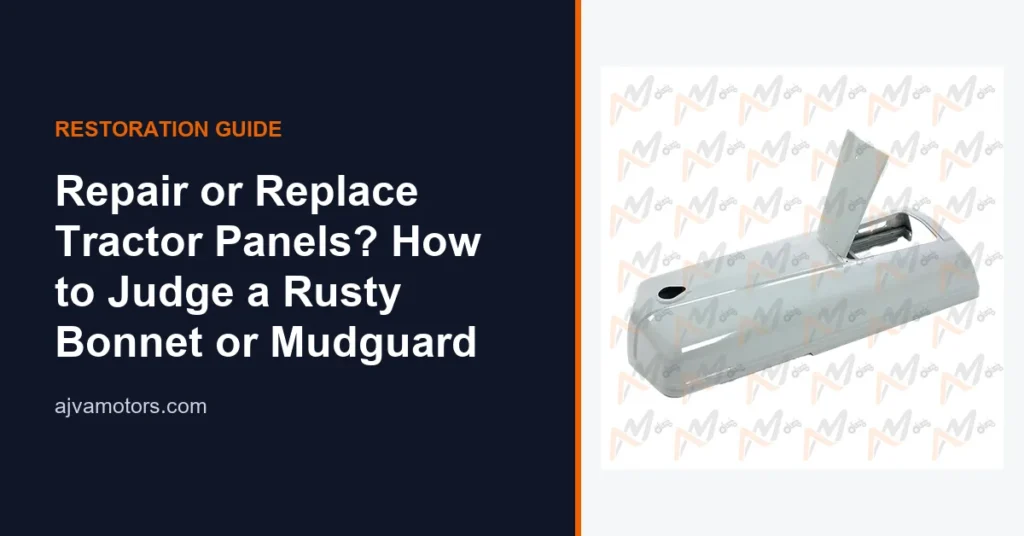
Should you repair or replace tractor panels? First strip or blast the panel, then judge the bare steel. Surface rust and a few pinholes are worth repairing. However, replace the panel when the rust has gone through in several places, the steel flexes under your thumb, the mounting points are cracked or torn, or the panel is bent out of line.
This guide is for restorers, workshops and parts dealers deciding what to do with a rusty bonnet (hood in the USA), mudguard (fender) or footplate. It gives you five checks, a table of what each finding means, and an honest view of when a repair costs less than a new panel. We make replacement panels, so we have said plainly where a repair is the better choice.
Last updated: 13 November 2026
Strip or blast first, then judge
Old paint hides most of the damage. Several coats can even protect a panel, so a bonnet that looks rough may be sound underneath. On the other hand, a smooth coat can hide filler over a hole. You cannot decide until you see bare metal.
In his guide to repairing a Ford 8N hood, John Korschot of the N Tractor Club strips the paint first. After that, he sandblasts the panel, and he notes that blasting has a way of finding holes. He also marks dents on the inside before blasting, because they are hard to see afterwards. If you cannot blast, chemical stripper or a wire wheel will do. Either way, work on both faces of the panel, because rust often starts on the inside.
Be ready for what blasting shows. On a TractorByNet thread about a rusty John Deere 4100, one member said deep rust blisters stay “clear as day” after blasting and painting. In other words, blasting cleans pitted steel, but it does not make it smooth again.
Five checks on a rusty tractor panel
Once the panel is bare, go over it with a good light, a centre punch and your thumb. Then use the table to sort each finding.
| What you find | What it means | Usual answer |
|---|---|---|
| Surface rust, no pitting | The steel is still full thickness | Repair: clean, prime and paint |
| A few pinholes in one area | Local rust, the panel around it is sound | Repair: punch, braze or weld, then fill |
| Rust-through holes in several places | The steel is thin across a wide area | Replace, unless the panel is rare |
| Steel flexes under thumb pressure | Too thin to hold a weld or keep its shape | Replace |
| Cracks or tears at bolt holes and brackets | The panel can no longer hold itself in place | Repair if one point; replace if several |
| Panel bent, twisted or out of line | Gaps to the next panel will not close | Replace if the whole panel is out of shape |
1. Pinholes
Hold the panel up to a light, or shine a torch from behind. Pinholes in one small area are a normal repair. Korschot drives small pinholes in with a centre punch and fills them with brass by brazing. If the pinholes spread over a large part of the panel, though, treat it as rust-through.
2. Rust-through
A hole you can push a finger through needs metal, not filler. On a TractorByNet thread about fixing rusty fenders, a member with long experience of fender repair says the only proper fix is to weld or braze in a metal patch. After that, body filler only smooths the surface. Another member gave the short version: cut back to good metal and weld patches in.
3. Thin steel
Press the panel with your thumb around the rusty areas. Good steel does not move. If it flexes, it is too thin to weld and too weak to keep its shape. The John Deere 4100 owner described a fender that bent under any pressure, with parts of it missing. That panel is past saving.
4. Cracks at mounting points
Check every bolt hole, bracket and folded edge. These points carry the panel’s weight and its vibration, and water sits in them. A single torn hole can be welded and redrilled. Several cracked mounts, however, mean the panel will keep shaking loose. Expect seized fixings too: the same 4100 owner found that the fender bolts snapped or stripped.
5. Distortion
Offer the panel up to the tractor, or lay it on a flat floor. A dent can be hammered out. A bonnet that has twisted, or a mudguard that has been bent by a tyre, is different. If the gaps to the grille, side panels or footplate will not close, you will spend hours in filler and still see it once the panel is painted.
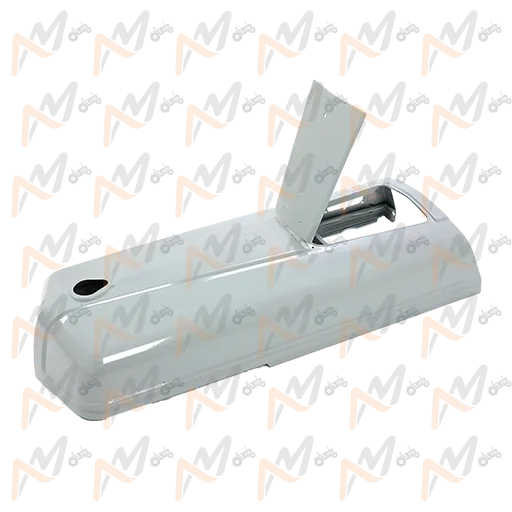
Tractor bonnet rust repair: where to look
Bonnets rust where water and dirt are trapped, not on the open top. On the Ford 8N, Korschot finds rust in the lower rib along the length of the hood, near the front and near the rear cross support. Similarly, in a TractorByNet thread on 8N rust repair, one owner says the bracing holds dirt and moisture with no good way to clean it out. Look there first on any bonnet: along the ribs, behind the bracing and around the hinges.
Tractor bonnet rust repair in those places is a skilled job. Korschot cuts out each damaged area, shapes a filler piece from an old hood or fender, and tacks it in. Then he welds in small areas and lets the metal cool between them to limit distortion. He finishes with filler, primer and a long session of wet sanding.
Rusty tractor fender or mudguard: where to look
On a rusty tractor fender, start at the folded outer edge and the bolt holes, where mud thrown up by the tyre collects and stays wet. Then check the inside face of the mudguard as carefully as the outside, and test each bolt hole for cracks.
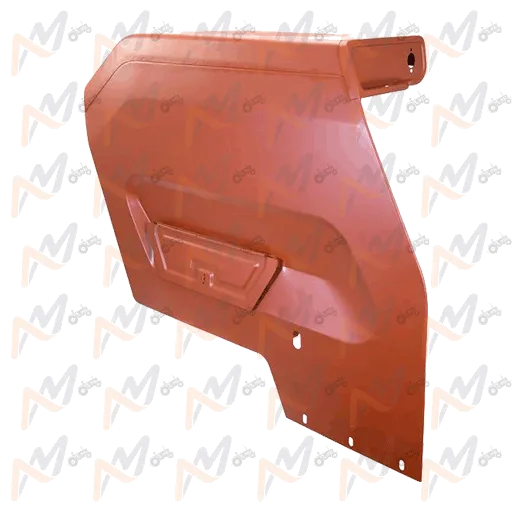
Some quick fixes do not last on a tractor. In the TractorByNet thread “Best way to fix these?”, about Kubota fenders, one member advised against fibreglass because it will never bond to the metal well enough. Another said the fenders were rusted through in places and could not simply be sanded and painted. For a working tractor, a filler patch may be enough for a season. For a restoration, it is not.
When a repair is the better choice
Repair is often cheaper, and sometimes it is the only sensible choice. Repair the panel when:
- the damage is in one or two small areas and the rest of the steel is sound;
- you have a welder or a brazing torch and the time, so the cost is mainly your own hours;
- the tractor is being restored to original, and the original panel matters to the owner or the buyer;
- no replacement is made for that model, or the original is heavier than the copies on offer. One 8N owner on TractorByNet makes this point about reproduction hoods.
When to replace the panel
Replace the panel when the checks above show rust-through in several places, thin steel, several cracked mounts or a twisted shape. Replace it too when the repair hours cost more than the panel. That can be the case for a workshop paying a welder, and for a dealer who sells the tractor rather than keeps it. A new panel also starts with clean steel inside and out, which matters on parts that trap water.
Repair or replace tractor panels: a quick checklist
- Strip or blast both faces of the panel to bare steel.
- Mark every hole, crack and dent with chalk.
- Press around each rusty area. If it flexes, replace the panel.
- Count the rust-through areas. One or two: repair. Many: replace.
- Check every bolt hole and bracket for cracks.
- Offer the panel up and check the gaps to the panels next to it.
- Price your repair hours against a new panel, including filler, primer and paint.
If you decide to replace
Keep the old panel until the new one is on the tractor. Its holes, brackets and shape are the best fitment guide you have. When you order, send the tractor model, the OEM number if it is stamped or listed, and a photo of the old panel from the front and the back.
We make replacement tractor bonnets, mudguards, bonnet kits and footplates for Massey Ferguson, Ferguson TE20, Ford 8N, Swaraj and other models, including the Ford 8N bonnet and the MF 135 and 148 mudguard shown above. To measure a mudguard before you order, see how to measure, check and order replacement mudguards. For the full order of checks on one tractor, read our Massey Ferguson 135 restoration tinwork guide.
Repair or replace: common questions
Can I fix rust holes in a tractor mudguard with body filler?
Not as a lasting repair. Filler only smooths a surface; it does not bridge a hole. Experienced repairers weld or braze in a metal patch first and then use filler to finish it. On a working tractor, filler alone may last a season.
Is it worth sandblasting a rusty bonnet?
Yes, if you plan to repair it. Blasting shows the holes and thin spots that paint hides. Mark the dents on the inside first, because they are hard to find on a blasted panel. Deep pitting will still show after blasting and painting.
How do I fix pinholes in a tractor bonnet?
One proven method is to drive each pinhole in with a centre punch and fill it with brass by brazing. Then fill, prime and sand. If pinholes cover a large area, the steel around them is thin, and a new panel is usually the better choice.
Are replacement panels thinner than the originals?
It depends on the maker. One 8N owner on TractorByNet says reproduction hoods are lighter than the originals. Compare the new panel with your original before you scrap the old one, and ask the supplier for a sample if you are buying in quantity.
What should I keep from the old panel?
Keep the whole panel until the new one fits. Also keep the brackets, hinges, badges and rubber pads, because a replacement panel may come without them.
Still unsure whether to repair or replace tractor panels on your tractor? Send photos of the stripped panel through our contact page, and we will tell you which of our panels fits.