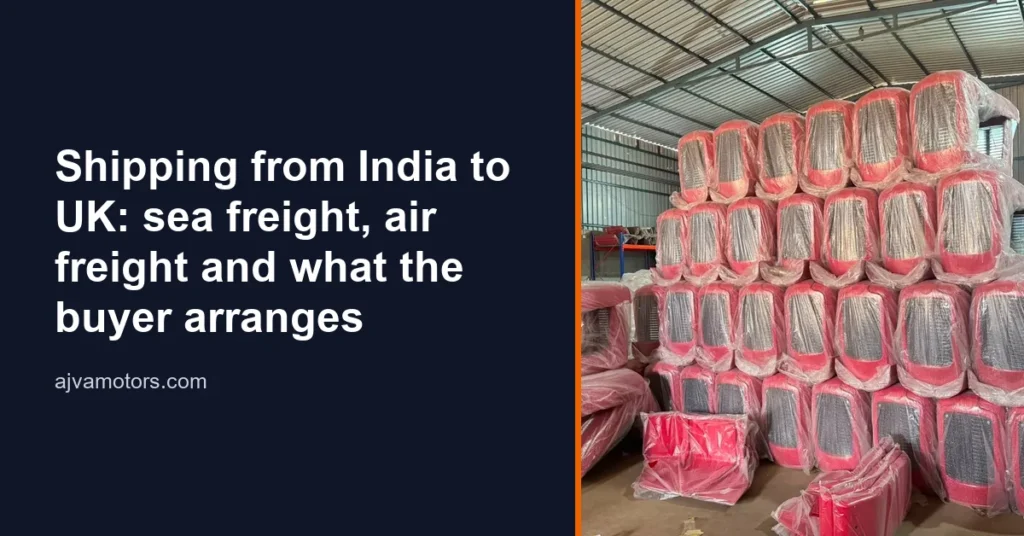
Shipping from India to UK by sea takes about 26 to 30 days port to port when ships use the Suez Canal, and 10 to 14 days longer when they sail round Africa. Air freight takes about 5 to 8 days door to door. Who books and pays for each leg depends on the Incoterm you agree: FOB, CFR or CIF.
This guide is for UK dealers, restorers and workshops buying tractor body parts from an Indian factory. It covers sea and air, full and shared containers, the Incoterm split, the UK rule on wooden crates and pallets, and a checklist of what you arrange yourself. Customs clearance and duty have their own guides, linked below, so this one stays on the freight.
Last updated: 16 November 2026
Sea or air: four ways of shipping from India to UK
Tractor body panels are large, light for their size and awkward to pack. So the choice is usually between a full container, a share of one, and air for a small or urgent order. The transit times below come from the freight forwarder Röhlig’s India to UK route guide.
| Method | Best for | Typical transit | What to watch |
|---|---|---|---|
| Full container (FCL) | A dealer’s stock order, mixed panels for several models | 26 to 30 days port to port via Suez | You pay for the whole box, so fill it |
| Shared container (LCL) | A few pallets or crates | Port to port as FCL, plus time to group and split the load | Priced on the space the cargo takes, so bulky panels cost more |
| Air freight | Samples, a missing panel holding up a job | 5 to 8 days door to door | Charged on size as well as weight |
| Express courier | One sample panel | 2 to 4 days | Usually the highest cost per kilo |
These are transit times only. They do not include the time the factory needs to make and pack the order. Therefore, ask the supplier for the ready date and the freight forwarder for the sailing, and add the two together.
Sea freight from India to UK: ports and transit times
Most India to UK container traffic leaves from Nhava Sheva (Mumbai) or Mundra on the west coast, or from Chennai and Tuticorin in the south. On the UK side, Röhlig names Felixstowe and London Gateway as the main ports. Other ports, such as Southampton or Tilbury, may be closer to your yard, so ask your forwarder what sails there.
When ships can use the Suez Canal and the Mediterranean, Röhlig gives 26 to 30 days port to port. However, when ships have to sail round Africa instead, the voyage takes 10 to 14 days longer. Check the routing when you book, because it changes the arrival date more than anything else.
Also allow time at both ends. In India, the exporter files a shipping bill with Indian Customs, and the goods can only go on board after customs gives a Let Export Order. In the UK, the container waits at the port until your customs agent clears it.
Full container or shared container?
A full container load (FCL) is a sealed box that only holds your goods. It is loaded at the supplier’s factory or a nearby yard and opened at your premises or the UK port. As a result, the panels are handled less, which matters for painted steel that scratches and dents.
A shared container (LCL) suits a smaller order. The forwarder groups your crates with other cargo, ships them, and then splits the load at a UK depot. Shared containers are priced on the space your cargo takes up or on its weight. Because body panels take up a lot of space for their weight, pack them to nest where they can. For example, mudguards of one model can often nest, while a bonnet takes more room.
Many UK buyers mix products in one container: bonnets, mudguards, grilles and footplates for several tractor models. That way, one shipment restocks a whole range. Ajva Motors has shipped four containers of mixed tractor body parts to the UK, and our minimum order is 5 pieces per product, so a mixed load is simple to plan.
Air freight from India to UK: when it pays
Air freight from India to UK makes sense for a sample before a container order, or for one panel that is holding up a restoration. However, it rarely pays for stock, because airlines charge on size as well as weight.
Maersk explains the chargeable weight rule: multiply length by width by height in centimetres and divide by 6,000. The airline then charges on that volume weight or the actual weight, whichever is higher. Some carriers divide by 5,000 instead, which makes bulky cargo dearer still.
Take an example carton of 120 x 60 x 40 cm holding 15 kg of panels. The volume weight is 120 x 60 x 40 / 6,000 = 48 kg. So you pay for 48 kg, more than three times the real weight. Light, bulky parts such as bonnets and mudguards usually charge on volume.
FOB, CFR or CIF: who arranges what
The Incoterm in your contract decides who books the ship and who insures the cargo. The ICC Incoterms 2020 rules are the reference. For sea freight, Indian suppliers usually quote one of three terms.
| Stage | FOB Indian port | CFR UK port | CIF UK port |
|---|---|---|---|
| Packing and transport to the Indian port | Supplier | Supplier | Supplier |
| Indian export clearance | Supplier | Supplier | Supplier |
| Booking and paying sea freight | You | Supplier | Supplier |
| Marine insurance | You | You | Supplier, minimum cover |
| UK port charges, customs, duty and VAT | You | You | You |
| Delivery from the UK port to your yard | You | You | You |
Under all three terms, the risk passes to you once the goods are on board in India. That is why insurance matters even when the supplier pays the freight. Under CIF, the ICC sets Institute Cargo Clauses (C) as the default cover, which is the minimum. If you want wider cover, agree it in the contract or insure the cargo yourself.
FOB suits a buyer who already has a forwarder with good India rates. CFR or CIF suits a first order, since the supplier books the ship and you deal only with the UK end. Whichever you choose, the term also changes the customs value. Our guide to customs clearance when you import from India to the UK shows how.
Packing: the UK rule on wooden crates and pallets
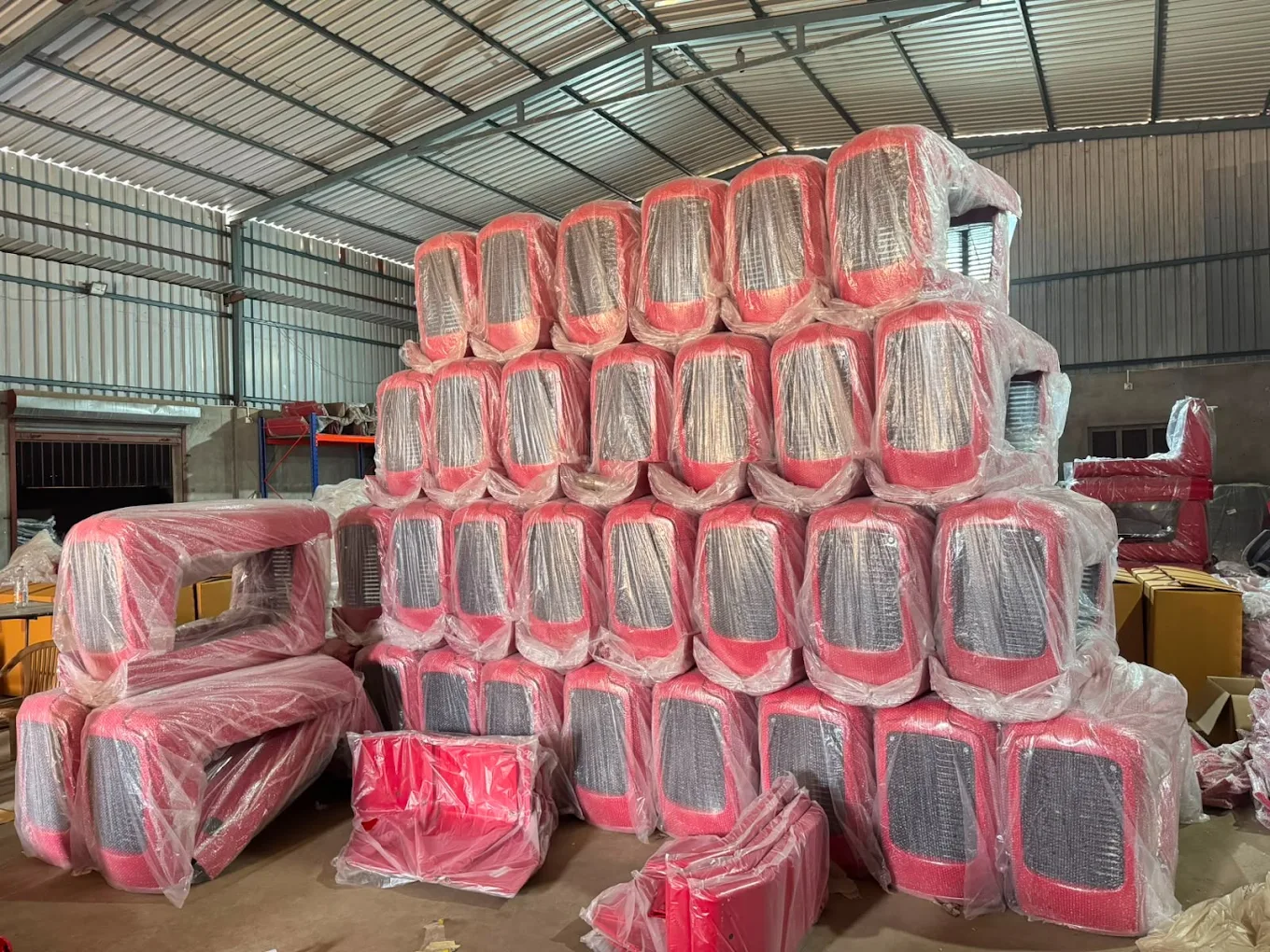
Sheet metal panels travel in crates, on pallets or wrapped in film and cartons. If the shipment uses solid wood, it must meet the ISPM 15 standard. GOV.UK’s guidance on wood packaging covers packing cases, crates, pallets and loose dunnage. Wood that fails the rules can be rejected or destroyed, and you then have to move the goods onto new packaging.
The rule does not apply to plywood, other processed wood, wood 6 mm thick or less, or cardboard. So ask the supplier two things before shipping: what the panels will be packed in, and whether any solid wood carries the ISPM 15 mark.
Documents you should receive
- Commercial invoice, with the Incoterm, the currency and a clear description of each part.
- Packing list, showing what is in each crate or carton with weights and sizes.
- Bill of lading for sea freight, or an air waybill for air freight.
- Proof of origin, if you want to claim the UK India trade deal tariff rate. Our article on the UK India trade deal for tractor parts explains what counts.
Ask for copies by email as soon as the ship sails. Then your customs agent can prepare the import declaration before the container arrives.
What the UK buyer arranges: a checklist
- Get a GB EORI number before the goods leave India.
- Agree the Incoterm and the UK port in writing.
- Under FOB, book a freight forwarder and confirm the sailing.
- Under FOB or CFR, insure the cargo from the moment it is on board.
- Appoint a customs agent and give them the commodity code. Tractor body parts usually fall under heading 8708 in the UK Trade Tariff.
- Plan import VAT, for example through postponed VAT accounting.
- Book delivery from the port, and check whether you need a tail lift or a forklift to unload.
- On arrival, photograph the crates before opening them and check every panel against the packing list.
Ordering panels from Ajva Motors
We make aftermarket tractor body parts at our factory in Gujarat and quote FOB India, CFR or CIF to a UK port. You can see the range on our UK export page, or start with tractor bonnet kits and tractor mudguards. A sample is available on request, and we reply to quotes within 24 to 48 hours on business days.
Shipping from India to UK: common questions
How long does sea freight from India to UK take?
About 26 to 30 days port to port when ships use the Suez Canal, and 10 to 14 days more when they sail round Africa. Add the time for export clearance in India, for the sailing date, and for UK clearance and delivery.
Is air freight worth it for tractor body panels?
Only for samples or an urgent panel. Airlines charge on volume weight, length times width times height in centimetres divided by 6,000, when it is higher than the real weight. Bonnets and mudguards are bulky, so they usually charge on volume.
Who pays UK import VAT and duty under CIF?
You do. CIF covers the freight and the minimum insurance to the UK port. UK port charges, customs clearance, duty and import VAT stay with the buyer under FOB, CFR and CIF alike.
Do wooden crates from India need an ISPM 15 mark?
Yes, if they are solid wood. GOV.UK says solid wood packaging entering Great Britain must meet ISPM 15. Plywood, processed wood, wood 6 mm thick or less and cardboard are outside the rule.
Can I put several products in one container?
Yes. Most dealers mix bonnets, mudguards, grilles and footplates for several models in one container. List each product as its own line with its quantity, so the packing list and the invoice match.
Planning shipping from India to UK for a parts order? Send us the parts, the quantities and your UK port through our contact page, and we will quote on the Incoterm you choose.