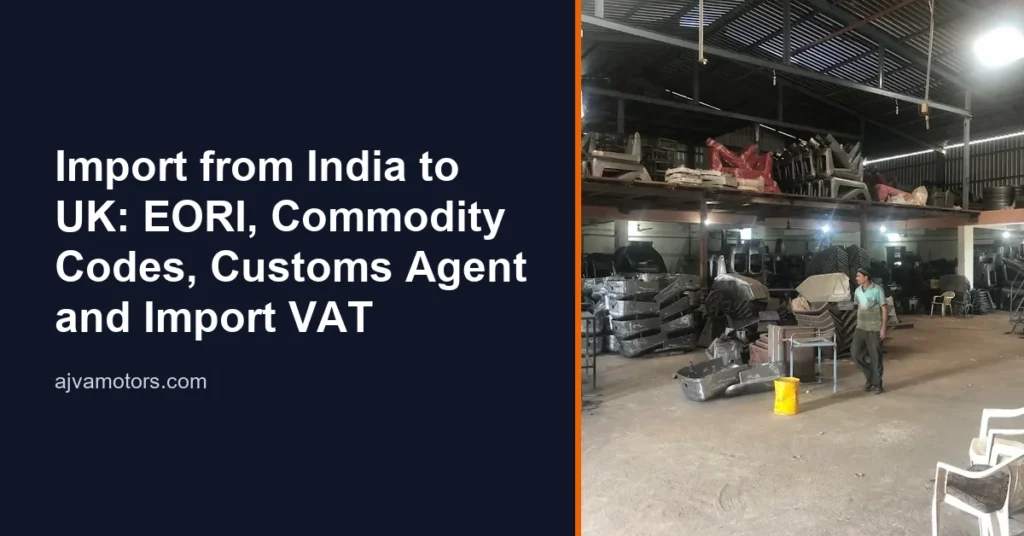
To import from India to UK ports, a business needs four things in place before the goods arrive: a GB EORI number, the correct commodity code, a customs agent who makes the import declaration, and a plan for import VAT. A VAT registered business can use postponed VAT accounting, so it pays no import VAT at the port.
This guide walks through each step for a consignment of tractor body parts shipped by sea, with a link to the GOV.UK page behind every rule. It covers the process. For the duty rate and proof of origin under the trade deal, read our guide to the UK India trade deal for tractor parts.
Last updated: 9 November 2026
Import from India to UK in seven steps
GOV.UK sets out the whole process on its Import goods into the UK step by step page. For a parts consignment, it comes down to these seven steps.
| Step | What you do | Who usually does it |
|---|---|---|
| 1 | Get a GB EORI number | You, once |
| 2 | Check the supplier and agree the Incoterm | You and the supplier |
| 3 | Find the commodity code | You, checked by your agent |
| 4 | Appoint a customs agent | You, once |
| 5 | Plan import VAT and duty payment | You and your accountant |
| 6 | Send the documents before arrival | Supplier and you |
| 7 | Keep the records | You |
Step 1: Get a GB EORI number to import from India to UK
GOV.UK says you need an EORI number “that starts with GB to import goods into England, Wales or Scotland”. It goes on every import declaration. Apply on the GOV.UK EORI application page. You will need:
- Unique Taxpayer Reference (UTR).
- Business start date and Standard Industrial Classification (SIC) code.
- VAT number and the date your VAT registration started, if you are VAT registered.
- National Insurance number, if you are a sole trader.
According to GOV.UK, you get the number immediately unless HMRC needs to make checks, which “can take up to 5 working days”. Therefore, apply before you place the order, not when the ship is already at sea.
Step 2: Check the supplier and agree the Incoterm
First, confirm that you are dealing with a real business. An Indian manufacturer registered for GST has a GSTIN you can look up on the government site. Our guide on how to check a tractor parts factory in India covers that and four other checks.
Next, agree the Incoterm, because it decides who books the ship and what you add to the customs value. GOV.UK says the costs of transport, insurance, loading or handling “connected with delivering the goods to the UK border must be included” in the customs value (Method 1, transaction value).
| Incoterm | Who pays sea freight | Who insures the voyage | Customs value starts from |
|---|---|---|---|
| FOB India | You | You | Invoice price plus your freight and insurance to the UK |
| CFR UK port | Supplier | You | Invoice price plus your insurance |
| CIF UK port | Supplier | Supplier | Invoice price, which already includes both |
However, with any of the three, you as the importer still pay UK duty and import VAT. In other words, CIF only moves the freight and insurance onto the supplier’s invoice.
Step 3: Find the commodity code for tractor parts
Every line on the declaration needs a commodity code. GOV.UK calls them “internationally recognised reference numbers”, and the guide to finding commodity codes points you to the Trade Tariff tool.
Steel body panels for tractors, such as bonnets, mudguards and grilles, usually fall under heading 8708, “Parts and accessories of the motor vehicles of headings 8701 to 8705”. Heading 8701 is tractors. Within that heading, the code most panels use is 8708 29 90 99, under “Other parts and accessories of bodies (including cabs)”. On 9 November 2026 the Trade Tariff showed:
- Third country duty: 4.00%.
- Preference for goods from India: 0.00%, from 15 July 2026, with valid proof of origin.
- VAT: 20%.
Note that the 0% rate is not automatic. The proof of origin it needs is explained in our trade deal guide. In addition, your customs agent confirms the final code for each line, and if a part is hard to classify, you can apply to HMRC for an Advance Tariff Ruling.
Step 4: Appoint a customs agent to clear your import from India to UK ports
In practice, many importers use a customs agent, often the freight forwarder’s own clearance team. The agent then submits the import declaration on the Customs Declaration Service. GOV.UK says your instruction to the agent “must show whether they’re acting for you directly or indirectly” (get someone to deal with customs for you). The difference matters:
- Direct representation. The agent acts in your name. You are solely liable for the accuracy of the declaration and for any duty or import VAT due.
- Indirect representation. The agent acts in its own name, so it shares the liability with you.
Give the agent your EORI number, your VAT number, the commodity code for each line and written instructions on postponed VAT accounting. Then send each shipment’s documents before the ship arrives:
- Commercial invoice, with a description and value for each line.
- Packing list, with the cases, weights and dimensions.
- Bill of lading.
- Proof of origin, if you are claiming the 0% trade deal rate.
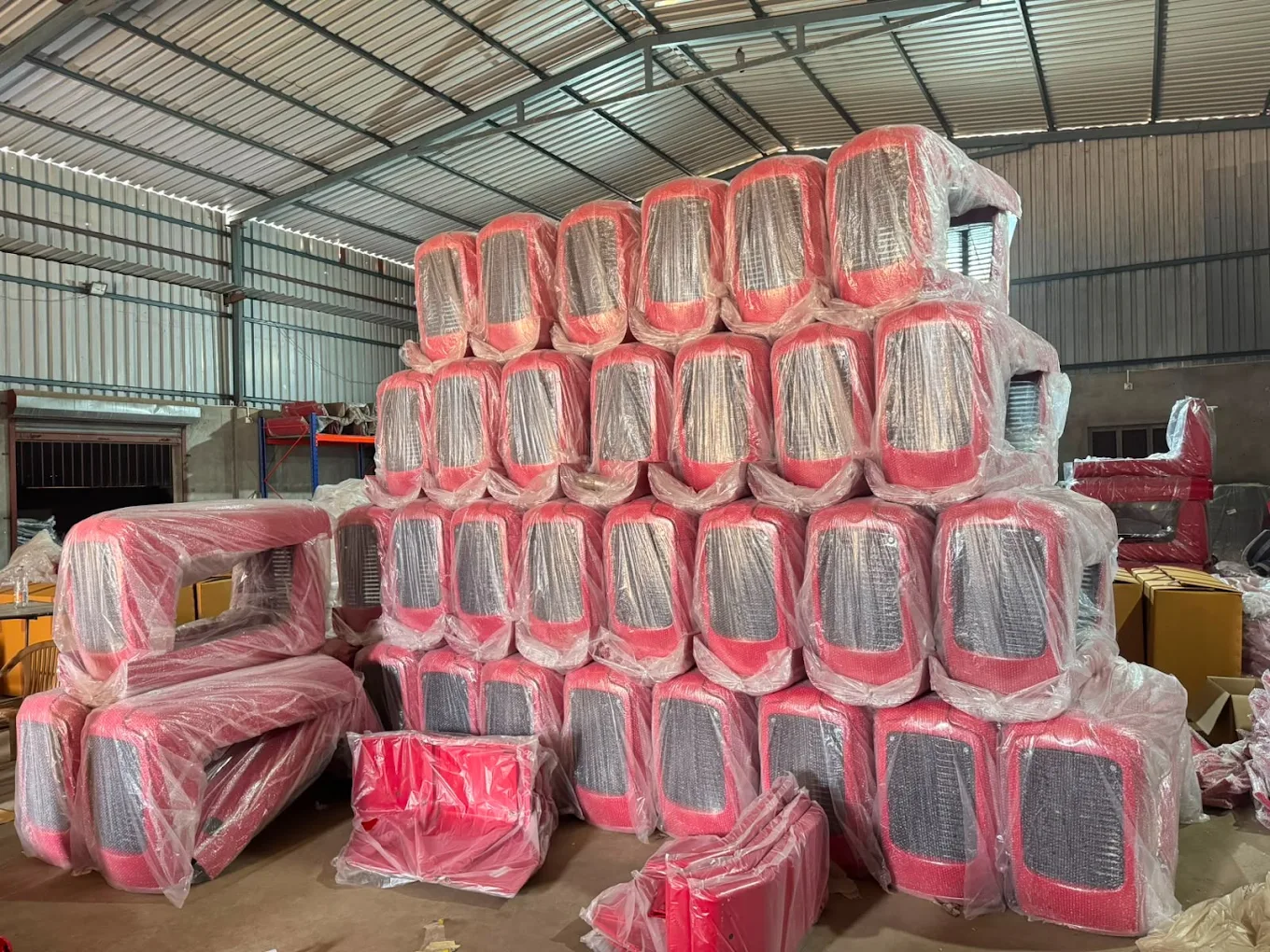
Step 5: Plan import VAT with postponed VAT accounting
HMRC charges import VAT at 20% on most parts. However, with postponed VAT accounting, you declare and reclaim it on the same VAT return instead of paying it at the port. The rules from GOV.UK:
- Your business “must be registered for VAT in the UK”.
- “You do not need any approval” to use it.
- Your VAT number goes on the import declaration, in Data Element 3/40, and you must be the consignee.
- Each import appears on a monthly postponed import VAT statement on the Customs Declaration Service, usually by the 10th working day of the month.
- You can only view a statement for 6 months, so download and keep each one.
On the VAT return, the postponed VAT goes in Box 1 as VAT due and in Box 4 as VAT reclaimed, and the value of the goods goes in Box 7. It belongs on the return for the period in which you imported the goods (completing your VAT return for import VAT).
Customs duty, on the other hand, is separate. If any is due, your agent can pay it and recharge you, or you can open a duty deferment account, which lets you pay once a month by Direct Debit. A deferment account needs a bank guarantee unless HMRC approves a guarantee waiver, which can cover up to £10,000 a month.
A worked example: import VAT when you import from India to UK
GOV.UK bases the VAT value on the customs value, plus costs such as transport “up to the goods’ first destination in the UK”, plus any duty (working out the VAT value). We made up the figures below to show the method, so they are not a quote.
| Line | With proof of origin | Without proof of origin |
|---|---|---|
| Customs value (CIF UK port) | £10,000 | £10,000 |
| Customs duty | 0%: £0 | 4%: £400 |
| Port handling and haulage to your warehouse | £350 | £350 |
| Value for VAT | £10,350 | £10,750 |
| Import VAT at 20% | £2,070 | £2,150 |
With postponed VAT accounting, the £2,070 goes in Box 1 and Box 4 of the same return. As a result, if you can reclaim all your input VAT, no import VAT leaves your bank. Without proof of origin, the £400 of duty is a real cost, and it also raises the VAT value.
Step 6: Send the documents before arrival
A container from India to a UK port is at sea for several weeks, so there is time to get the paperwork right. Before you import from India to UK ports, ask the supplier for draft documents as soon as the goods are packed. Then check that the commercial invoice and packing list agree, and that every line has a clear part description and value. Forward everything to your agent before the ship docks. A missing document, or a description the agent cannot match to a code, can hold the container at the port.
Step 7: Keep the records
Finally, GOV.UK says you must keep records for all traded goods you declare to HMRC “for 4 years”, and VAT records “for at least 6 years” (archiving your trade documents). For each consignment, keep the commercial invoice, the packing list, the bill of lading, the proof of origin, the import declaration from your agent and the postponed VAT statement.
Checklist before you import from India to UK
- GB EORI number issued.
- VAT registered, if you want postponed VAT accounting.
- Supplier checked, and the Incoterm agreed in writing.
- Commodity code for each line, checked with your agent.
- Customs agent appointed, with direct or indirect representation stated.
- Written instruction to the agent to use postponed VAT accounting.
- Proof of origin arranged, if you are claiming the 0% rate.
- Duty payment method chosen: through the agent, or a deferment account.
- A folder ready for the documents, kept for at least 4 years.
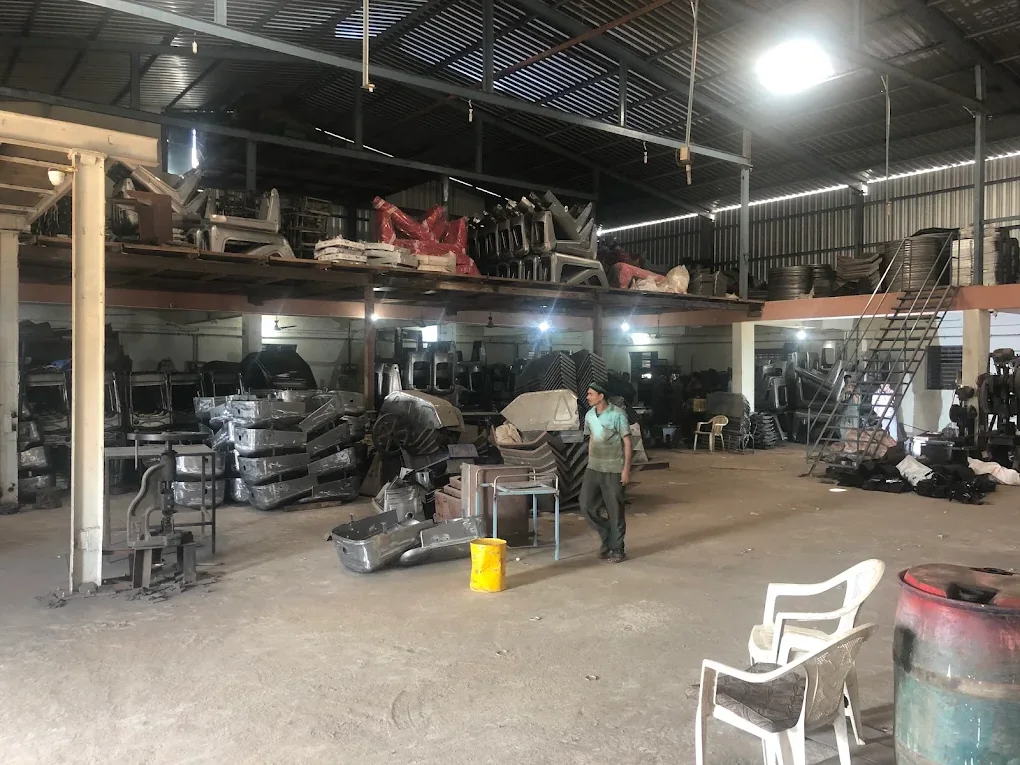
Ajva Motors ships tractor body panels to UK buyers in mixed sea containers and quotes FOB India, CFR or CIF to a UK port. Each shipment comes with a commercial invoice and a packing list. See our tractor body parts supplier for the UK page for the ports, transit times and the parts we make, or the full tractor body parts catalogue.
Frequently asked questions
Do I need an EORI number to import from India to UK?
Yes, for a business importing into England, Scotland or Wales. You need an EORI number that starts with GB. HMRC usually issues it immediately, but its checks can take up to 5 working days.
Can I use postponed VAT accounting if I am not VAT registered?
No. GOV.UK says the business must be registered for VAT in the UK. Without VAT registration, you pay import VAT when the goods are cleared, usually through your customs agent.
Who pays UK duty and VAT if I buy CIF?
You do, as the importer. CIF means the supplier pays the sea freight and insurance to the UK port. However, you still declare and pay UK duty and import VAT.
What is the duty on tractor body panels from India?
Under commodity code 8708 29 90 99, the Trade Tariff showed 4% third country duty and 0% for goods from India with valid proof of origin, as of 9 November 2026. Even so, your agent confirms the code for each part.
How long must I keep import records?
At least 4 years for customs records and at least 6 years for VAT records. Also download each postponed VAT statement, because you can only view it online for 6 months.
Planning to import from India to UK for the first time? Send your part list through the UK quote form, and we will reply within 24 to 48 hours on business days.