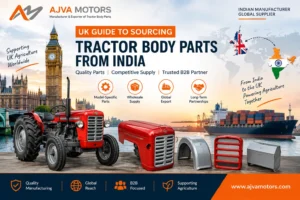
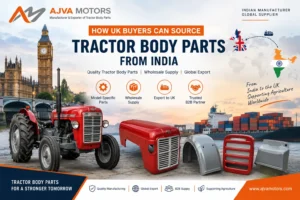
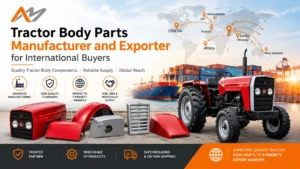
India has become an important sourcing destination for agricultural machinery and tractor body parts, serving buyers across domestic and international markets. For distributors, importers, tractor dealers, wholesalers, agricultural equipment companies, and machinery businesses, choosing the right OEM tractor parts exporter is essential for maintaining product quality, supply consistency, and customer satisfaction.
Tractor parts used in agriculture must withstand demanding working environments. Mud, dust, rain, vibration, heavy loads, changing temperatures, and continuous field operation can place significant stress on tractor components. For this reason, international buyers need more than a company that can simply ship products overseas. They need an experienced manufacturing and export partner capable of delivering consistent specifications and dependable quality.
AJVA Motors is an Indian manufacturer and exporter of tractor and truck body parts, supplying products for agricultural machinery businesses, dealers, distributors, wholesalers, OEM customers, and international buyers.
Our manufacturing capabilities include tractor body components such as:
- Tractor bonnets
- Bonnet tops
- Bonnet side panels
- Tractor mudguards
- Tractor fenders
- Front grilles
- Grille assemblies
- Footplates
- Body panel assemblies
- Tractor body part kits
This guide explains how to choose a reliable tractor parts exporter in India, what international buyers should check before placing an order, and why manufacturing capability matters when sourcing tractor parts for overseas markets.
Quick Answer: How Do You Choose a Tractor Parts Exporter in India?
The best tractor parts exporter in India should combine manufacturing capability, consistent product quality, model-specific compatibility, quality inspection, bulk production capacity, secure export packaging, and reliable international supply.
For OEM and aftermarket buyers, it is generally advantageous to work with a company that manufactures the tractor parts itself rather than relying entirely on third-party sourcing.
A manufacturer-exporter can provide better control over:
- Product dimensions
- Material quality
- Manufacturing consistency
- Production quantities
- Quality inspection
- Packaging
- Long-term availability
What Is an OEM Tractor Parts Exporter?
An OEM tractor parts exporter is a company that supplies tractor components manufactured according to original equipment specifications or OEM-style dimensional and quality requirements and exports those products to international markets.
The term OEM can be particularly important for buyers who need replacement parts that match the original tractor design.
Depending on the product, OEM-focused manufacturing may involve:
- Model-specific dimensions
- Original-style profiles
- Accurate mounting points
- Consistent material specifications
- Repeatable production
- Controlled manufacturing processes
- Quality inspection
For body parts such as bonnets, mudguards, grilles, fenders, and side panels, dimensional accuracy is especially important because even small differences can make installation difficult.
Why Source Tractor Parts from India?
India has a large agricultural machinery ecosystem and a strong manufacturing base for tractor components and replacement body parts.
International buyers often consider India because of the combination of:
Manufacturing Expertise
Indian manufacturers have extensive experience in sheet metal fabrication, pressing, welding, forming, painting, and agricultural machinery components.
Competitive Manufacturing Costs
Indian production can provide competitive pricing while allowing manufacturers to maintain scalable production.
Wide Tractor Compatibility
The Indian agricultural market includes a large number of tractor brands and models, creating extensive experience in manufacturing replacement components.
Skilled Workforce
Experienced fabricators, welders, engineers, quality inspectors, and production workers contribute to manufacturing capabilities.
Export Infrastructure
Manufacturers serving international customers can support packaging, documentation, logistics coordination, and overseas shipments.
Manufacturer vs Supplier vs Exporter
International buyers often use these terms interchangeably, but they describe different roles.
| Business Type | Main Function |
|---|---|
| Manufacturer | Produces the tractor part |
| Supplier | Provides parts to customers or distributors |
| Exporter | Handles international sales and shipments |
| Manufacturer-Exporter | Produces the parts and exports them directly |
For large or recurring orders, a manufacturer-exporter can provide an important advantage because production and export operations are managed within the same supply chain.
Why Direct Manufacturer Sourcing Can Be Better for International Buyers
Consider a distributor importing 500 tractor mudguards.
If the distributor purchases through several intermediaries, the final products may come from different production sources. This can create differences in:
- Sheet thickness
- Dimensions
- Paint finish
- Mounting holes
- Bracket design
- Packaging
- Overall quality
Now consider sourcing directly from one established manufacturer.
The manufacturer can maintain consistent:
Design → Material → Production → Inspection → Packaging → Export
This consistency is particularly valuable for international distributors who need to sell the same product repeatedly.
What Tractor Body Parts Can Be Exported?
A professional tractor parts exporter in India may supply a broad range of agricultural machinery components.
Tractor Bonnets
Tractor bonnets protect the engine compartment and form a major part of the tractor’s exterior body.
Common products include:
- Bonnet tops
- Bonnet kits
- Bonnet side panels
- Front grilles
- Bonnet assemblies
Tractor Mudguards
Mudguards protect operators and surrounding components from mud, water, stones, and agricultural debris.
Depending on the tractor model, buyers may require:
- Rear mudguards
- Extension mudguards
- Fender assemblies
- Mudguard kits
- Model-specific replacement mudguards
Tractor Grilles
Front grilles provide protection while contributing to engine airflow and the tractor’s original appearance.
Tractor Footplates
Footplates provide operator access and form an important structural component of many tractor body assemblies.
Tractor Body Panel Kits
Complete kits can be useful for:
- Tractor restoration
- Major body repairs
- Dealer inventory
- Fleet refurbishment
- Agricultural machinery workshops
Real-World Example: A Distributor Importing Tractor Body Parts
Imagine a tractor spare-parts distributor in an overseas agricultural market.
The distributor receives regular requests for:
- Tractor bonnets
- Mudguards
- Front grilles
- Side panels
- Fender components
Instead of purchasing each component from different suppliers, the distributor partners with an Indian manufacturer-exporter.
The manufacturer provides consistent products across multiple tractor models and prepares the order for international shipment.
This arrangement can simplify:
- Product sourcing
- Quality inspection
- Order management
- Packaging
- Logistics coordination
- Repeat purchasing
For a growing distributor, having one reliable manufacturing partner can make the supply chain significantly easier to manage.
What Makes a Good Tractor Parts Exporter?
Before selecting an exporter, international buyers should evaluate several factors.
1. Manufacturing Capability
Ask whether the exporter actually manufactures the products or sources them from third parties.
A manufacturer-exporter generally has greater control over product specifications.
2. Product Range
A broader product range can simplify sourcing.
Look for suppliers capable of producing multiple categories such as:
Bonnets + Mudguards + Grilles + Fenders + Footplates + Body Kits
3. Quality Control
Ask about:
- Raw material inspection
- Dimensional inspection
- Welding inspection
- Surface finishing
- Final product inspection
- Packaging inspection
4. Bulk Production
International distributors often require larger quantities.
Confirm that the exporter can maintain consistent quality across large production batches.
5. Export Packaging
Tractor body parts can be large and vulnerable to scratches and deformation.
Proper packaging should protect products during:
- Factory handling
- Truck transportation
- Container loading
- Sea freight
- Warehouse handling
- Final delivery
6. Long-Term Availability
For distributors, one successful shipment is not enough.
A reliable tractor parts exporter should be capable of supporting repeat orders and maintaining consistent product specifications.
AJVA Motors as an OEM Tractor Parts Manufacturer & Exporter
AJVA Motors combines manufacturing and export capabilities to serve customers looking for dependable tractor body parts.
Our approach focuses on:
- Precision sheet metal manufacturing
- Model-specific product development
- Consistent production
- Quality inspection
- Bulk order capability
- Export-ready packaging
- Long-term supply relationships
Our goal is to help international buyers source tractor body parts from India through a dependable manufacturing partner rather than an inconsistent supply chain.
For more information about our manufacturing capabilities, visit:
Tractor Body Parts Manufacturer in India – AJVA Motors
Key Takeaways
If you are searching for a tractor parts exporter in India, focus on more than price.
A reliable exporter should provide:
✔ Manufacturing capability
✔ OEM-quality production
✔ Accurate model compatibility
✔ Consistent raw materials
✔ Quality inspection
✔ Bulk production
✔ Secure export packaging
✔ International supply capability
✔ Repeat-order support
For international buyers, these factors are often more important than simply finding the lowest quotation.
How Tractor Body Parts Are Manufactured
A professional manufacturing process generally follows a controlled sequence:
Design & Model Verification → Raw Material → Cutting → Press Forming → Welding → Finishing → Quality Inspection → Packaging → Export
Each stage affects the final product.
1. Tractor Model & Product Specification
Before manufacturing begins, the required tractor model and product specification must be identified.
A bonnet for one tractor model cannot automatically be used on another model simply because the two tractors belong to the same brand.
Manufacturers may need to verify:
- Tractor brand
- Exact model
- Body configuration
- Product dimensions
- Mounting locations
- Bracket positions
- Curvature
- Clearance requirements
- Original-style design
This model-specific approach is especially important for OEM tractor parts and replacement body panels.
2. Raw Material Selection
The quality of the finished tractor part depends heavily on the raw material.
For sheet-metal body components, manufacturers select materials according to the product’s intended application and manufacturing requirements.
Important considerations include:
- Material strength
- Formability
- Thickness
- Surface quality
- Welding characteristics
- Corrosion resistance
A manufacturer that uses inconsistent raw materials may produce parts with varying strength, appearance, and dimensions.
For export customers placing repeat orders, maintaining consistent material specifications is particularly important.
3. Precision Sheet Metal Cutting
Once the material has been selected, it is cut according to the required component dimensions.
Accurate cutting helps manufacturers achieve:
- Consistent dimensions
- Clean edges
- Reduced material waste
- Repeatable production
- Better forming accuracy
For products manufactured in large quantities, precision at this stage helps maintain consistency from one production batch to another.
4. Press Forming
Many tractor body components require curved or shaped profiles.
Flat sheet metal is therefore formed using appropriate press-forming processes and tooling.
This is particularly important for:
- Tractor bonnets
- Mudguards
- Fenders
- Side panels
- Grilles
- Other curved body components
Precision forming helps achieve the correct profile while maintaining consistency between individual products.
A poorly formed body panel may look acceptable at first glance but can create problems during installation if its curvature or dimensions are incorrect.
5. Bracket & Reinforcement Manufacturing
Some tractor body parts require additional supports, brackets, or reinforcement sections.
These components provide structural support at areas exposed to:
- Vibration
- Repeated movement
- Mounting stress
- External impact
- Heavy field operation
For example, mounting areas on a tractor mudguard may require additional reinforcement because the component is continuously exposed to vibration while the tractor is operating.
6. Welding & Assembly
Where a body component consists of multiple sections, welding and assembly become critical manufacturing stages.
Professional welding should provide:
- Strong joints
- Consistent penetration
- Clean finishing
- Proper alignment
- Structural stability
Poorly aligned or weakly welded components can develop cracks or deformation during use.
For an OEM tractor parts manufacturer, welding quality must remain consistent across production batches.
7. Surface Preparation
Before painting or protective finishing, the metal surface needs to be properly prepared.
Surface preparation can involve removing:
- Oil
- Dust
- Welding residue
- Burrs
- Surface contaminants
Good preparation improves coating adhesion and contributes to a more durable final finish.
8. Protective Coating & Finishing
Tractors operate outdoors and are frequently exposed to:
- Rain
- Mud
- Humidity
- Fertilizers
- Soil
- Agricultural chemicals
- Temperature changes
Therefore, corrosion protection is an important consideration for tractor body parts.
A properly finished component can provide better resistance against environmental exposure while maintaining its appearance.
The final finish should also be consistent across products when supplying distributors and international customers.
9. Dimensional Inspection
Before a tractor part is approved for dispatch, important dimensions should be checked against the required specifications.
Depending on the product, inspection may include:
- Overall length
- Width
- Height
- Curvature
- Mounting hole position
- Bracket alignment
- Component thickness
- Assembly dimensions
Dimensional consistency is especially important for replacement parts because customers expect the new component to install correctly on the intended tractor.
10. Visual & Structural Inspection
Dimensional accuracy is only one part of quality control.
Finished products should also be examined for:
- Surface defects
- Welding defects
- Sharp edges
- Deformation
- Cracks
- Paint irregularities
- Damaged mounting points
A comprehensive inspection process helps prevent defective products from entering the export supply chain.
OEM Tractor Parts vs Aftermarket Tractor Parts
International buyers frequently ask about the difference between OEM and aftermarket products.
| OEM / OEM-Style Production | General Aftermarket Production |
|---|---|
| Model-specific specifications | Specifications may vary |
| Focus on accurate fitment | Fitment may require adjustment |
| Consistent manufacturing | Quality can vary by supplier |
| Repeatable production | Production standards may differ |
| Detailed quality control | Inspection may be limited |
| Suitable for professional distribution | Quality depends heavily on source |
Not every aftermarket part is low quality. An experienced aftermarket manufacturer can produce excellent replacement components.
The important factor is manufacturing control and product consistency.
Why Consistency Matters for Exporters
Consider an international distributor ordering 100 mudguards today and another 100 six months later.
If the manufacturer changes:
- Material thickness
- Tooling
- Bracket design
- Mounting hole position
- Surface finish
the second shipment may not match the first.
This can create inventory problems for distributors and customers.
For this reason, a professional tractor parts exporter in India should maintain consistent manufacturing specifications for repeat orders.
Quality Control at Different Manufacturing Stages
Quality should not be treated as something that happens only at the end of production.
A better approach is to control quality throughout the manufacturing process.
Incoming Material
Check material specifications and surface condition.
Cutting
Verify dimensions and edge quality.
Forming
Check shape, curvature, and deformation.
Welding
Inspect joints, alignment, and structural integrity.
Finishing
Check coating quality and surface appearance.
Final Inspection
Verify dimensions, fitment-related features, appearance, and overall condition.
Packaging
Ensure products are adequately protected before dispatch.
This stage-by-stage approach reduces the chance of defects reaching international customers.
Why Export Packaging Matters for Tractor Parts
Tractor body parts can be large, shaped, and vulnerable to scratches or deformation.
A product that leaves the factory in perfect condition can still arrive damaged if it is not packaged correctly.
Export packaging should therefore consider:
- Product dimensions
- Component shape
- Surface finish
- Stacking requirements
- Handling
- Moisture exposure
- Transportation distance
Proper packaging helps protect products throughout the export journey.
Manufacturing Multiple Tractor Brands
International buyers may need parts for several tractor brands rather than a single manufacturer.
An experienced tractor body parts exporter can simplify sourcing by providing products for multiple brands through one manufacturing relationship.
AJVA Motors manufactures tractor body parts for applications involving brands such as:
- Massey Ferguson
- Ferguson
- Ford
- John Deere
- Mahindra
- Eicher
- Sonalika
- Swaraj
The exact availability depends on the tractor model and product.
This multi-brand capability can be particularly useful for international distributors maintaining mixed tractor-part inventories.
Tractor Body Parts Suitable for Export
The manufacturing process can be applied to a wide range of tractor body components.
Tractor Bonnets
Used to cover and protect the engine area while forming a major part of the tractor’s exterior.
Tractor Mudguards
Designed to reduce mud, water, and debris thrown from the wheels.
Tractor Fenders
The term “fender” is particularly common in North American markets and is often used interchangeably with mudguard.
Front Grilles
Provide protection and contribute to the tractor’s front-end appearance and airflow design.
Side Panels
Used as body panels around the engine and bonnet assembly.
Footplates
Provide operator access and form part of the tractor body structure.
Complete Body Kits
Useful for restoration, refurbishment, fleet maintenance, and major body replacement projects.
Why Manufacturers Are Important for OEM and Bulk Buyers
A distributor purchasing small quantities may focus primarily on availability and price.
A large international buyer has different requirements.
They need:
Consistency + Capacity + Quality + Repeatability + Export Support
A manufacturer can provide greater control over these factors than a trading-only business.
For example, when a distributor discovers that a particular tractor mudguard sells well in its market, it may need regular replenishment. Working directly with the manufacturer makes it easier to establish repeat production and maintain the same product specifications.
AJVA Motors: Manufacturing for Domestic & International Markets
AJVA Motors combines tractor body parts manufacturing with international supply capabilities.
Our product categories include:
- Tractor bonnets
- Tractor bonnet kits
- Tractor mudguards
- Tractor fenders
- Front grilles
- Side panels
- Footplates
- Tractor body part assemblies
Our manufacturing approach is focused on accurate model-specific production, consistent quality, and dependable supply for customers purchasing tractor body parts for domestic or export markets.
For buyers looking for a broader tractor body parts manufacturing partner, you can explore the main manufacturing page:
Tractor Body Parts Manufacturer in India – AJVA Motors
What International Buyers Should Ask Before Ordering
Before placing a bulk order with a tractor parts exporter in India, ask these questions:
Product
- What tractor model is the part designed for?
- Is the product OEM-compatible?
- Are mounting points manufactured according to the required specification?
Manufacturing
- Are the parts manufactured in-house?
- What materials are used?
- How is dimensional accuracy controlled?
- What quality inspections are performed?
Supply
- What is the minimum order quantity?
- Can repeat orders be manufactured to the same specification?
- Can the supplier handle bulk quantities?
Export
- Is export packaging available?
- Can the supplier support international shipments?
- What documentation is provided for export orders?
Getting clear answers to these questions before ordering can prevent costly misunderstandings later.
Key Takeaway
The difference between an ordinary supplier and a professional OEM tractor parts exporter is not simply the ability to ship products internationally.
A reliable export partner should control the complete process:
Manufacturing → Quality Control → Packaging → Supply → Export
When these stages are properly managed, international buyers can build a more reliable tractor parts supply chain and confidently serve their own customers.
What Should International Buyers Look for in a Tractor Parts Exporter?
A professional exporter should be evaluated across several areas rather than on price alone.
The most important factors are:
- Manufacturing capability
- Product quality
- Model compatibility
- Production capacity
- Quality control
- Product range
- Packaging
- Export experience
- Repeat-order capability
- Communication and business support
A supplier that performs well across these areas is more likely to become a reliable long-term sourcing partner.
1. Manufacturer or Trading Company?
One of the first questions an importer should ask is:
“Are you the manufacturer or a trading company?”
A trading company can be useful when sourcing multiple products, but direct manufacturer relationships can provide greater control over product specifications.
A tractor parts manufacturer and exporter can potentially control:
- Raw materials
- Production methods
- Tooling
- Product dimensions
- Welding
- Surface finishing
- Quality inspection
- Packaging
This can be particularly important when purchasing tractor body parts in bulk.
2. Check the Exporter’s Tractor Parts Range
A strong exporter should ideally offer more than one type of tractor body part.
For example, an importer may initially need mudguards but later require:
- Bonnet tops
- Bonnet kits
- Side panels
- Front grilles
- Fender assemblies
- Footplates
- Complete body kits
Working with a manufacturer that produces several categories can simplify sourcing and reduce the number of separate suppliers required.
Tractor Body Parts Export Categories
AJVA Motors manufactures a broad range of tractor body components for domestic and international customers.
Tractor Bonnets
Tractor bonnets are among the most visible body components and are frequently required for replacement and restoration.
Products can include:
- Bonnet tops
- Bonnet side panels
- Bonnet kits
- Front bonnet sections
- Grille assemblies
Tractor Mudguards
Mudguards protect the operator and surrounding tractor components from mud, water, stones, and debris.
They are also commonly referred to as tractor fenders in several international markets.
AJVA Motors manufactures model-specific mudguards for multiple tractor brands.
Tractor Grilles
Front grilles protect the front section of the tractor while contributing to the original appearance of the machine.
Tractor Side Panels
Side panels are commonly replaced when the original component has been damaged, heavily corroded, or requires restoration.
Tractor Footplates
Footplates provide access to the operator area and form an important part of the tractor body structure.
Complete Tractor Body Kits
For restoration projects and major refurbishment, customers may require multiple components rather than a single replacement part.
A complete body kit can simplify sourcing by bringing compatible components together.
3. Consider Tractor Brand Coverage
International markets often contain a mixture of older and newer tractor models.
An exporter with experience across several brands can therefore be more useful to distributors.
AJVA Motors manufactures body parts for applications involving brands such as:
- Massey Ferguson
- Ferguson
- Ford
- John Deere
- Mahindra
- Eicher
- Sonalika
- Swaraj
Product availability varies by model, so buyers should always confirm the exact tractor application before placing an order.
4. OEM vs Aftermarket Export Orders
Not every international buyer has the same requirements.
Some customers need replacement parts for tractors currently operating in the field. Others require components for restoration or aftermarket distribution.
OEM / OEM-Style Buyers
Typically prioritize:
- Accurate dimensions
- Consistent specifications
- Repeatability
- Production capacity
- Quality control
Aftermarket Buyers
May prioritize:
- Availability
- Competitive pricing
- Product range
- Replacement compatibility
- Flexible order quantities
A capable OEM tractor parts exporter should be able to understand the buyer’s application and manufacture according to the required specifications.
5. Bulk Tractor Parts Export
International distributors generally purchase larger quantities than individual tractor owners.
For example, a distributor may order:
- 100 mudguards
- 50 bonnet tops
- 50 grille sets
- 25 bonnet kits
The exact quantity depends on the market and tractor models being served.
For bulk orders, consistency becomes extremely important.
A manufacturer should be able to maintain:
Same specification → Same dimensions → Same quality → Same finish
across production batches.
Why Bulk Buyers Prefer Direct Manufacturers
Consider two sourcing options.
Option A: Multiple Traders
The buyer purchases different products through several intermediaries.
This can create differences in:
- Product quality
- Dimensions
- Finishing
- Packaging
- Delivery schedules
Option B: One Manufacturing Partner
The buyer works with a direct manufacturer for multiple product categories.
This can simplify:
- Purchasing
- Quality control
- Communication
- Inventory management
- Packaging
- Logistics
For growing distributors, consolidating sourcing can make the supply chain easier to manage.
6. Ask About Repeat Orders
A successful first shipment is not enough for a serious distributor.
Suppose a tractor body part becomes popular in an overseas market. The buyer may need the same product every month or every quarter.
The exporter should be capable of reproducing the same specification consistently.
This is why repeat-order capability is an important factor when selecting a tractor parts exporter.
7. Product Identification Is Critical
Tractor parts should be identified by more than a general product name.
For example:
“John Deere mudguard”
is not necessarily enough information.
A professional buyer should confirm:
- Exact model
- Part type
- Left/right configuration if applicable
- Product dimensions
- Mounting arrangement
- Application
- Product photographs
- OEM/reference number where available
This helps prevent incorrect orders and reduces unnecessary returns.
8. Product Documentation Helps International Buyers
Professional product information should clearly explain what the component is designed for.
Useful product information includes:
- Product name
- Tractor brand
- Compatible model
- Application
- Material information where appropriate
- OEM/reference number where applicable
- Product dimensions where relevant
- Product photographs
- Installation-related information
Clear information makes it easier for international distributors to add products to their own catalogs and websites.
9. Export Packaging for Tractor Body Parts
Large tractor body parts require careful packaging.
A mudguard or bonnet can be damaged by improper stacking, handling, or transportation.
A reliable exporter should consider:
Surface Protection
Prevent scratches and paint damage.
Structural Protection
Prevent bending or deformation.
Moisture Protection
Reduce exposure to moisture during transportation and storage.
Secure Packing
Prevent unnecessary movement during transportation.
For international shipments, packaging should be selected according to the product shape, shipment method, and destination.
10. Why Indian Tractor Parts Can Be Attractive for Global Buyers
India has a large domestic tractor market, which creates extensive manufacturing experience in agricultural machinery components.
For international buyers, this ecosystem can offer:
- Competitive manufacturing
- Skilled fabrication
- Tractor model expertise
- Large production capability
- Broad product categories
- Export-oriented manufacturers
This combination makes India an important sourcing destination for tractor parts exporters, especially for body components and replacement parts.
Real-World Example: Overseas Tractor Parts Distributor
Consider a distributor serving an agricultural region where older Massey Ferguson, Ford, John Deere, and other tractor models remain active.
The distributor needs replacement body parts because many tractors are still working even though their original body panels have deteriorated.
Instead of sourcing each part from different suppliers, the distributor works with one Indian manufacturer-exporter.
The supplier provides:
- Model-specific mudguards
- Tractor bonnets
- Front grilles
- Side panels
- Fender components
- Body kits
The distributor can then maintain a broader inventory while working with one primary manufacturing partner.
This type of relationship can be particularly valuable in markets where tractors remain in service for many years and replacement body parts are regularly required.
Tractor Parts for Restoration Projects
Older tractors often require more than mechanical replacement parts.
A restoration project may require:
- Bonnet
- Mudguards
- Grille
- Side panels
- Footplates
- Fender components
- Mounting brackets
For restoration specialists, appearance and dimensional compatibility are particularly important.
An experienced tractor body parts exporter can help restoration businesses source several components from one manufacturing source.
Why Massey Ferguson and Ferguson Parts Have Strong Replacement Demand
Older Massey Ferguson and Ferguson tractors remain important in many agricultural markets.
Because some of these tractors have been operating for decades, their original body panels may suffer from:
- Rust
- Dents
- Cracks
- Previous accident damage
- Corrosion around mounting areas
- General deterioration
Replacement body parts allow owners to restore the appearance and usability of these tractors without replacing the entire machine.
AJVA Motors manufactures various Ferguson and Massey Ferguson body components, supporting both restoration and replacement requirements.
Tractor Parts Exporter vs Tractor Body Parts Exporter
These keywords may appear similar but can represent slightly different search intent.
Tractor Parts Exporter
A broad term that can include:
- Body parts
- Mechanical parts
- Electrical components
- Hydraulic components
- Engine parts
Tractor Body Parts Exporter
A more specific term focused on exterior and structural body components such as:
- Bonnets
- Mudguards
- Fenders
- Grilles
- Side panels
- Footplates
For AJVA Motors, the second category closely matches the company’s manufacturing specialization.
Why AJVA Motors Is a Strong Choice for Tractor Body Parts Export
AJVA Motors focuses on manufacturing tractor and truck body parts rather than operating solely as a trading business.
Our capabilities support buyers looking for:
Manufacturing
Production of tractor body components using sheet metal fabrication and forming processes.
Multiple Tractor Brands
Products for a range of established tractor brands and model applications.
Product Variety
Bonnets, mudguards, grilles, side panels, fenders, footplates, and body kits.
Bulk Supply
Support for distributors, wholesalers, dealers, and commercial buyers.
Export Supply
Products prepared for domestic and international customers.
Consistent Production
A manufacturing-focused approach designed to maintain product consistency across orders.
For buyers researching an OEM tractor parts exporter in India, the manufacturing capability behind the exporter should always be considered alongside price and shipping terms.
Questions to Ask Before Choosing an Exporter
Before finalizing a supplier, international buyers can use this checklist:
Manufacturing
- Are you the manufacturer?
- Where are the products manufactured?
- What manufacturing processes are used?
Product
- Which tractor models are supported?
- Are products OEM-compatible?
- Can model-specific requirements be accommodated?
Quality
- How are products inspected?
- How is dimensional accuracy checked?
- How is surface quality controlled?
Orders
- What quantities can you manufacture?
- Can you support repeat orders?
- Can you maintain consistent specifications?
Export
- How are products packaged?
- Can you support international shipments?
- What export documentation is provided?
Business Relationship
- Can you support long-term supply?
- Can you provide multiple product categories?
- How is communication handled during production?
A manufacturer that can answer these questions clearly is more likely to provide a dependable sourcing experience.
Building a Long-Term Tractor Parts Supply Partnership
The strongest exporter relationships are built around consistency rather than one-time transactions.
For example:
Initial Order → Quality Evaluation → Repeat Order → Larger Volume → Long-Term Supply
As the buyer’s confidence increases, the relationship can expand into additional tractor models and product categories.
A distributor that initially purchases mudguards may eventually source:
Mudguards → Bonnets → Grilles → Side Panels → Footplates → Complete Body Kits
This creates a more efficient supply relationship for both the buyer and manufacturer.
Internal Product Examples
AJVA Motors’ existing tractor body parts demonstrate the range of model-specific products that can be manufactured and supplied.
For example, buyers can explore products such as:
- Eicher tractor mudguards
- John Deere mudguards
- Mahindra mudguards
- Massey Ferguson mudguards
- Ferguson bonnet components
- Ford 8N bonnet and fender components
- Swaraj bonnet components
For buyers interested in the wider manufacturing range, the main tractor body parts manufacturing page provides an overview of the category:
AJVA Motors Tractor Body Parts Manufacturer in India
Key Takeaway for International Buyers
Choosing a tractor parts exporter in India should be based on the complete supply chain rather than the quoted price alone.
The strongest manufacturing-export partners combine:
Product Knowledge + Manufacturing + Quality Control + Capacity + Packaging + Export Support
For distributors, wholesalers, dealers, and importers, this combination can make it easier to maintain reliable inventory and serve customers across different tractor models.
Step-by-Step Process for Buying Tractor Parts from India
Step 1: Identify Your Tractor Parts Requirement
Start by creating a clear product requirement.
Include:
- Tractor brand
- Exact tractor model
- Product name
- Required quantity
- OEM/reference number if available
- Left/right specification where applicable
- Intended market
- Required finish
- Packaging requirements
For example, instead of requesting:
“Massey Ferguson mudguards”
provide:
“Massey Ferguson tractor mudguard – specific model – required quantity – export order.”
The more specific the requirement, the easier it is for the manufacturer to confirm compatibility.
Step 2: Select the Right Manufacturing Partner
When comparing tractor parts exporters in India, determine whether the company is:
- A manufacturer
- A manufacturer-exporter
- A trading company
- A distributor
For OEM and bulk requirements, a manufacturer-exporter can provide greater control over production and product consistency.
Look for experience in:
- Tractor body parts
- Sheet metal fabrication
- Press forming
- Welding
- Product finishing
- Quality inspection
- Export packaging
Step 3: Confirm Product Compatibility
Before placing an order, confirm that the product matches the intended tractor.
Ask for:
- Compatible model
- Product photographs
- Dimensions where necessary
- Mounting information
- OEM/reference number where available
- Product drawings if required for bulk/OEM projects
This is especially important for older tractors because several model variants may have visually similar body components.
Step 4: Request Product & Commercial Information
For larger orders, international buyers should request complete commercial information before confirming production.
This may include:
- Product specification
- Quantity
- Unit price
- Minimum order quantity
- Production lead time
- Packaging method
- Shipping terms
- Payment terms
- Export documentation
Clear communication at the beginning helps avoid misunderstandings later.
Step 5: Evaluate Product Quality
Price should not be the only deciding factor.
Evaluate:
Material
Is the sheet metal suitable for the intended application?
Forming
Does the body panel have the correct profile and curvature?
Mounting
Are holes, brackets, and fixing points correctly positioned?
Welding
Are joints strong and properly finished?
Surface
Is the product adequately protected against corrosion?
Overall Fitment
Does the component correspond with the intended tractor model?
Step 6: Confirm Bulk Production Capability
If you are purchasing for distribution, ask whether the exporter can manufacture repeat quantities.
For example, if an importer orders 200 tractor mudguards every quarter, the manufacturer should be capable of maintaining consistent:
- Dimensions
- Material specifications
- Bracket design
- Surface finishing
- Packaging
Long-term consistency is one of the most important characteristics of a professional OEM tractor parts exporter.
Step 7: Discuss Export Packaging
Tractor body parts can be difficult to transport because of their size and shape.
Before ordering, discuss:
- Individual protection
- Stacking
- Moisture protection
- Surface protection
- Bundle arrangement
- Loading requirements
Proper packaging helps reduce damage during international transportation.
Step 8: Plan Repeat Orders
If you intend to distribute the products in your market, consider future requirements before placing the first order.
A good manufacturing relationship should support:
Sample/Initial Order → Quality Approval → Bulk Order → Repeat Production → Long-Term Supply
This approach can help distributors build a reliable inventory system.
OEM Tractor Parts vs Aftermarket Parts: Which Should You Choose?
The right choice depends on the application.
| Requirement | Recommended Option |
|---|---|
| Original-style restoration | OEM/OEM-style |
| Professional tractor dealership | OEM/OEM-style |
| Fleet maintenance | Quality replacement |
| General aftermarket distribution | Quality aftermarket |
| Large wholesale order | Consistent manufacturer |
| Restoration of older tractors | Model-specific replacement |
The most important factor is not simply the label “OEM” or “aftermarket.”
Manufacturing quality, compatibility, and consistency matter.
Common Mistakes International Buyers Should Avoid
Mistake 1: Choosing Only on Price
The lowest quotation may not represent the lowest total cost.
Poor fitment, damaged products, premature corrosion, and inconsistent quality can increase the actual cost.
Mistake 2: Not Confirming the Exact Model
A product designed for one tractor model may not fit another variant.
Always confirm compatibility before ordering.
Mistake 3: Ignoring Product Dimensions
For large body components, dimensions can be critical.
When necessary, provide drawings, measurements, photographs, or existing-part references.
Mistake 4: Ordering Without Discussing Packaging
Large body parts require appropriate protection.
Always discuss packaging before confirming an export order.
Mistake 5: Working with Too Many Suppliers
Using separate suppliers for every product category can complicate:
- Purchasing
- Quality control
- Communication
- Logistics
- Inventory management
A manufacturer capable of supplying multiple tractor body parts can simplify the process.
International Buyer Quality Checklist
Before approving a shipment, buyers can evaluate:
Product Identification
☐ Correct tractor brand
☐ Correct tractor model
☐ Correct product
☐ Correct quantity
Manufacturing
☐ Correct dimensions
☐ Correct mounting points
☐ Good forming quality
☐ Strong welding
☐ Proper reinforcement
Finishing
☐ Acceptable surface finish
☐ Adequate corrosion protection
☐ No significant scratches or dents
Packaging
☐ Secure packaging
☐ Surface protected
☐ Product protected against deformation
☐ Suitable for international transportation
Documentation
☐ Commercial documents
☐ Packing information
☐ Product identification
☐ Required export documentation
Why Tractor Body Parts Are an Important Export Category
Tractors often remain operational for many years.
Even when the mechanical systems continue working, exterior body components can deteriorate due to:
- Weather
- Rust
- Accidents
- Field debris
- Continuous vibration
- General wear
- Previous repairs
This creates ongoing demand for replacement body components.
For international distributors, this means tractor body parts can serve both:
New-equipment markets + Replacement/Restoration markets
Replacement Parts for Older Tractors
Older tractors can remain economically valuable to farmers because they are familiar, mechanically simple, and relatively easy to maintain.
However, body panels may deteriorate long before the tractor becomes unusable.
A tractor may still have a functional engine, transmission, and hydraulic system while requiring replacement:
- Bonnet
- Mudguard
- Fender
- Grille
- Side panel
- Footplate
This creates an opportunity for international spare-parts distributors sourcing from an experienced tractor body parts exporter.
AJVA Motors – Tractor Body Parts Manufacturing & Export
AJVA Motors manufactures tractor and truck body parts for domestic and international customers.
Our product categories include:
- Tractor bonnets
- Tractor bonnet kits
- Tractor mudguards
- Tractor fenders
- Front grilles
- Side panels
- Footplates
- Tractor body part assemblies
Our manufacturing-focused approach allows buyers to source multiple body-part categories from one company.
For more information about our manufacturing capabilities:
Tractor Body Parts Manufacturer in India – AJVA Motors
Frequently Asked Questions
Who is a tractor parts exporter in India?
A tractor parts exporter in India supplies tractor components manufactured or sourced in India to international customers. A manufacturer-exporter can additionally control the production process before exporting the products.
What is an OEM tractor parts exporter?
An OEM tractor parts exporter supplies tractor components manufactured according to original or OEM-style specifications and serves international customers requiring consistent product quality and compatibility.
Can I buy tractor body parts directly from an Indian manufacturer?
Yes. Buyers can source tractor body parts directly from Indian manufacturers that serve international markets. Direct sourcing can simplify communication, quality control, and repeat orders.
What tractor body parts can be exported from India?
Common export categories include tractor bonnets, mudguards, fenders, grilles, side panels, footplates, bonnet kits, and other sheet-metal body components.
Can tractor parts be supplied in bulk?
Yes. Manufacturers can supply bulk orders for distributors, wholesalers, dealers, agricultural equipment companies, and other commercial buyers, subject to product and production requirements.
Do Indian tractor parts manufacturers support older tractor models?
Some manufacturers specialize in replacement and restoration components for older tractor models. Buyers should provide the exact tractor model and product requirement so compatibility can be confirmed.
What should I check before importing tractor body parts?
Check the tractor model, product dimensions, material, mounting points, finish, quantity, packaging, production capability, and export arrangements before placing an order.
Is buying directly from a tractor parts manufacturer better than buying from a trader?
For many OEM and bulk requirements, direct manufacturer sourcing can provide greater control over specifications, quality, production consistency, and repeat orders.
Can one exporter supply multiple tractor brands?
Yes. Manufacturers with a broad product range can supply body parts for multiple tractor brands and models, depending on their available product range and tooling.
Why is India a major sourcing destination for tractor parts?
India has a large agricultural machinery industry, experienced manufacturing workforce, established sheet-metal fabrication capabilities, and a growing export ecosystem.
What is the difference between a tractor parts supplier and exporter?
A supplier provides products to customers, while an exporter specifically handles international sales and shipment processes. A manufacturer-exporter combines production and international supply.
How can I find a reliable tractor parts exporter in India?
Look for a company with genuine manufacturing capability, product expertise, quality control, bulk production capacity, appropriate packaging, and experience serving international customers.
Can AJVA Motors supply tractor body parts internationally?
AJVA Motors manufactures tractor and truck body parts and serves domestic and international customers. Buyers should contact the company directly for current product availability, quantities, specifications, and export requirements.
Final Conclusion
Choosing the right tractor parts exporter in India can make a significant difference to the reliability of an international tractor-parts business.
A dependable export partner should provide more than competitive pricing. International buyers need:
- Manufacturing Capability
- Consistent Quality
- Model-Specific Compatibility
- Bulk Production
- Quality Inspection
- Secure Packaging
- Export Support
When these capabilities work together, importers, distributors, dealers, wholesalers, and OEM buyers can build a more reliable supply chain.
AJVA Motors combines tractor body parts manufacturing with export capabilities, supplying products such as tractor bonnets, mudguards, fenders, grilles, side panels, footplates, and body kits for multiple tractor applications.
If you are searching for an OEM tractor parts exporter, tractor body parts exporter, or tractor parts manufacturer in India, evaluate the manufacturer’s production capabilities, quality standards, product range, and ability to support long-term orders – not just the initial price.
AJVA Motors is ready to support businesses looking to source quality tractor body parts from India for domestic distribution, wholesale, OEM, replacement, restoration, and international export markets.