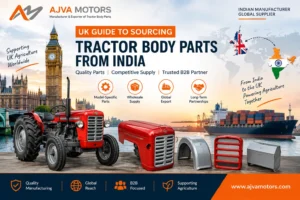
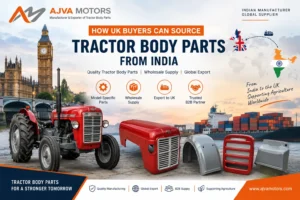
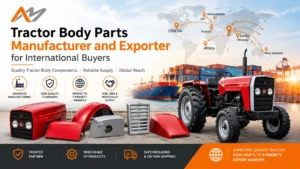
When a tractor body component is damaged, worn out or missing, choosing the correct replacement is just as important as finding a supplier. A bonnet, mudguard, fender or grille may look simple, but the dimensions, mounting points, shape and tractor model all affect whether the replacement will fit correctly.
For buyers searching for OEM tractor body parts, the first step is understanding what “OEM” actually means and how it differs from genuine, original-style and aftermarket replacement parts.
For businesses sourcing multiple components, working with an experienced tractor body parts manufacturer in India can also make it easier to identify model-specific products and establish a reliable supply relationship.
1. What Are OEM Tractor Body Parts?
OEM tractor body parts are components associated with the original equipment manufacturing specifications of a tractor.
The term OEM is commonly used when discussing parts designed, produced or supplied according to the specifications associated with the original equipment manufacturer. However, buyers should be careful with terminology because genuine OEM parts, OEM-equivalent parts, original-style replacements and aftermarket parts are not necessarily the same thing.
For a tractor owner, workshop, dealer or importer, the more important question is:
Does the replacement body part match the intended tractor application and provide the required fit, construction and finish?
This is particularly important for body components such as:
- Tractor bonnets
- Bonnet tops
- Bonnet kits
- Front grilles
- Mudguards
- Fenders
- Fender brackets
- Side panels
- Footplates
- Other sheet-metal body components
For example, a buyer looking for a replacement Ferguson TE20 body component may need to consider not only the tractor model but also the exact component and its mounting arrangement. AJVA Motors lists model-specific Ferguson TE20 body components, including an original-style fender and bracket.
Ferguson TE20 Fender and Bracket as Original
This type of model-specific product is useful when explaining why buyers should identify the exact application before ordering.
2. OEM vs Genuine OEM vs Original-Style vs Aftermarket
One of the most common problems when buying tractor body parts is assuming that all replacement parts described as “OEM,” “original” or “replacement” are identical.
They are not necessarily interchangeable terms.
Genuine OEM Parts
A genuine OEM part is supplied through the original equipment manufacturer’s parts system or an authorized source, depending on the specific product and market.
These parts are generally associated directly with the original manufacturer.
OEM-Equivalent Parts
An OEM-equivalent replacement is designed or manufactured to meet comparable functional or dimensional requirements.
For buyers, the important factors remain:
- Correct application
- Dimensions
- Mounting points
- Material
- Construction
- Finish
Original-Style Replacement Parts
An original-style replacement is designed to reproduce the appearance, shape or construction characteristics of an original component.
This can be particularly relevant when restoring older tractors.
For example, a Ferguson TE20 restoration project may require a fender and bracket designed around the original configuration rather than a generic universal panel.
Aftermarket Replacement Parts
Aftermarket parts are produced for the replacement market outside the original equipment manufacturer’s own parts supply chain.
Aftermarket does not automatically mean poor quality.
The buyer should evaluate the actual product, manufacturer, specifications and fitment rather than judging quality only from the word “aftermarket.”
3. Why the Difference Matters When Buying Tractor Body Parts
A tractor bonnet or mudguard is not simply a decorative component.
A correctly designed body part should work with the surrounding components and mounting structure.
For example, a replacement bonnet may need to align with:
- Front grille
- Side panels
- Mounting brackets
- Tractor frame
- Hood supports
- Existing fasteners
Similarly, a mudguard may need to align correctly with its mounting brackets and surrounding tractor components.
A part can look very similar in an online photograph but still require modification if the dimensions or mounting points are different.
That is why buyers should focus on compatibility and application, not just the product title.
4. Why Tractor Model Identification Is Important
One of the first things a buyer should provide when looking for OEM tractor body parts is the exact tractor model.
The brand alone may not be enough.
For example, a buyer searching for a Massey Ferguson bonnet should identify the specific model before selecting a product.
A Massey Ferguson 135 bonnet is not automatically suitable for every Massey Ferguson tractor.
AJVA Motors has model-specific Massey Ferguson body components such as the:
Massey Ferguson 135 Bonnet Top
and
Massey Ferguson 135 Bonnet Kit
These examples demonstrate an important purchasing principle:
Identify the tractor model first, then select the body component.
5. Original-Style Tractor Body Parts for Older Tractors
Older tractors often create a different sourcing requirement.
A tractor undergoing restoration may have:
- Rusted body panels
- Damaged original components
- Missing brackets
- Previous modifications
- Repainted panels
- Non-original replacement parts
In these cases, buyers may specifically search for original-style tractor body parts rather than generic replacement panels.
The objective may be to restore the tractor’s original appearance while retaining practical fitment.
For example, a Ferguson TE20 restoration can involve several related components rather than just one panel.
The buyer may need a bonnet, grille, fender and mounting components that work together.
AJVA Motors has a dedicated Ferguson TE20 bonnet top:
This type of model-specific sourcing is more useful than selecting a generic bonnet based only on appearance.
6. What Does O/M Mean on Tractor Body Parts?
Buyers may also encounter terminology such as O/M when searching for replacement tractor body components.
O/M can be used in the replacement-parts market to indicate an original-model/original-pattern type of product, depending on the supplier’s terminology.
Therefore, buyers should not rely on the abbreviation alone.
They should still check:
- Product description
- Tractor model
- Dimensions
- Mounting arrangement
- Product photographs
- Supplier information
For example, AJVA Motors lists a:
and a model-specific:
Massey Ferguson 1035 O/M Mudguard
These are useful examples of why the model name and product specification should be considered together with the O/M terminology.
7. Why Fitment Should Come Before Price
Price is naturally important when purchasing tractor parts, especially for workshops, dealers and distributors.
However, the lowest-priced component is not necessarily the lowest-cost solution.
If a body part does not fit correctly, the buyer may have to deal with:
- Additional fabrication
- Drilling new holes
- Bracket modification
- Repainting
- Alignment problems
- Installation delays
- Additional labour
For an individual tractor owner, this can increase the overall repair cost.
For a workshop or dealer, an incorrect component can also consume valuable time.
Therefore, the better purchasing approach is:
Correct Application → Correct Fitment → Appropriate Quality → Price
rather than:
Lowest Price → Hope It Fits
8. What Should You Check Before Buying OEM Tractor Body Parts?
Before ordering a tractor bonnet, mudguard, fender, grille or other body component, collect as much information as possible.
Tractor Brand
For example:
- Massey Ferguson
- Ferguson
- Ford
- John Deere
- Eicher
- Mahindra
- Swaraj
- Case International
- Sonalika
Exact Tractor Model
The model is often more important than the brand alone.
Component Required
Clearly state whether you need:
- Bonnet
- Bonnet top
- Bonnet kit
- Mudguard
- Fender
- Grille
- Side panel
- Bracket
Photographs
Clear photographs of the existing part and surrounding mounting area can help identify the application.
Dimensions
Where possible, provide relevant dimensions.
Part Number
If an OEM or reference number is available, include it.
Quantity
This is particularly important for dealers, distributors and export buyers.
9. OEM Tractor Body Parts Are Not Limited to One Component
When people search for OEM tractor body parts, they may actually be looking for an entire group of components.
A tractor’s exterior body can include:
Bonnet
↓
Front Grille
↓
Side Panels
↓
Mudguards / Fenders
↓
Brackets
↓
Footplates
A buyer restoring an older tractor may therefore require several components from the same model family.
This is why a manufacturer or supplier with a wider tractor body-parts range can be useful for workshops, dealers and international buyers.
For the broader category, buyers can explore:
Tractor Body Parts Manufacturer in India
10. A Practical Example: Choosing a Massey Ferguson Body Part
Consider a buyer who owns a Massey Ferguson 135 and needs to replace a damaged bonnet.
Instead of searching only for:
“tractor bonnet”
the buyer should search and verify:
Massey Ferguson 135 bonnet → correct component → dimensions → mounting → finish → supplier
A model-specific product such as the Massey Ferguson 135 bonnet top gives the buyer a more precise starting point than a generic tractor bonnet listing.
If the buyer requires a complete bonnet assembly, they can also investigate the corresponding bonnet kit.
This model-specific approach reduces the risk of selecting an incompatible body component.
How to Choose the Correct OEM Tractor Body Parts
Choosing the right OEM tractor body parts is not only about finding a product with the correct tractor brand in its name. The exact model, component type, dimensions, mounting points and surrounding body structure all need to be considered before placing an order.
This is especially important when buying tractor bonnets, mudguards, fenders, grilles and other sheet-metal body components. A replacement part may look similar to the original but still require modification if it was designed for a different model or configuration.
The following steps can help tractor owners, workshops, dealers, distributors and exporters select the right replacement body parts with greater confidence.
11. Start With the Exact Tractor Model
The first step is always to identify the exact tractor model.
Knowing only the manufacturer is usually not enough.
For example, a buyer searching for a Massey Ferguson bonnet should specify the model whenever possible. A Massey Ferguson 135 bonnet may have different dimensions and mounting arrangements from a bonnet designed for another Massey Ferguson model.
This is why model-specific product pages are important when researching tractor body parts.
For example, buyers looking for a Massey Ferguson 135 bonnet can review the:
Massey Ferguson 135 Bonnet Top
If a complete bonnet assembly is required, the buyer can also compare the:
Massey Ferguson 135 Bonnet Kit
The important point is simple:
Brand identification is the starting point. Model identification is the next step.
12. Identify the Exact Body Component
The phrase “tractor body part” can refer to many different components.
Before contacting a supplier, clearly identify what you actually need.
Common tractor body components include:
- Bonnet top
- Complete bonnet kit
- Front grille
- Bonnet grille
- Side bonnet panel
- Mudguard
- Fender
- Extension mudguard
- Fender bracket
- Footplate
- Front body panel
For example, a customer looking for a bonnet top should not automatically order a complete bonnet kit.
Similarly, someone looking for a damaged mudguard should determine whether they need the complete mudguard, an extension section or a related mounting component.
Clear identification helps prevent unnecessary purchases and makes supplier communication easier.
13. Compare the Existing Part With the Replacement
If the original component is still available, compare it carefully with the replacement product.
Look at:
Overall Shape
Check whether the replacement follows the same general profile as the existing part.
Width and Height
Measure the relevant dimensions where possible.
Curves and Pressed Sections
Sheet-metal body parts often contain formed sections that affect fitment.
Mounting Holes
Compare the number and position of mounting holes.
Brackets
Check whether brackets are integrated into the component or supplied separately.
Openings
For grilles and bonnet panels, compare the location and shape of openings.
This comparison can be particularly useful for older tractors where the original body may have been repaired or modified during its working life.
14. Check Mounting Points Before Ordering
Mounting points are one of the most important aspects of tractor body-part fitment.
A replacement panel may have the correct general dimensions but still fail to install correctly if the mounting holes or brackets are positioned differently.
Before ordering, check:
- Number of mounting holes
- Hole position
- Bracket location
- Bolt spacing
- Supporting frame position
- Adjacent component alignment
This is particularly important for bonnet kits, mudguards and fender assemblies.
A component that requires extensive modification may increase installation time and labour costs.
For workshops and commercial buyers, this can be more expensive than selecting the correct part from the beginning.
15. Use Photographs to Help Identify the Correct Part
Clear photographs can be extremely useful when communicating with a tractor body parts manufacturer or supplier.
When requesting a replacement, consider providing:
- A photograph of the entire tractor
- A photograph of the damaged component
- A close-up of the mounting area
- A photograph of the opposite side, if available
- A photograph showing the surrounding body components
- Any available identification plate or model information
Photographs should preferably be taken in good lighting and from several angles.
This can help the supplier understand the application rather than relying only on a product name.
16. Check Part Numbers and Reference Numbers
If the original part has an OEM number, reference number or manufacturer identification number, keep it available.
A reference number can help narrow down the correct product, particularly when several body components have similar names.
However, buyers should not rely exclusively on a number copied from an old part.
Older tractors can have:
- Replacement components
- Previous repairs
- Modified mounting points
- Non-original panels
- Different configurations
Therefore, the part number should ideally be considered together with the tractor model and physical characteristics.
17. Consider the Material and Construction
The quality of a tractor body part is not determined by appearance alone.
Buyers should consider how the component is manufactured and finished.
Important areas include:
Sheet-Metal Quality
The material should be appropriate for the intended body application.
Forming and Pressing
Pressed components should maintain the required shape and profile.
Welding
Where brackets or sections are welded, the construction should be suitable for the application.
Surface Preparation
Proper surface preparation is important before painting or finishing.
Paint and Finish
The final finish affects appearance and can also influence protection against environmental exposure.
For commercial buyers, consistency between batches is also important when ordering the same product repeatedly.
18. Don’t Choose Tractor Body Parts Only by Price
Price is an important part of any purchasing decision, but it should not be the only consideration.
Suppose a workshop finds two similar-looking tractor mudguards.
One costs less, but the mounting holes do not align correctly.
The workshop may then need to:
- Modify the part
- Drill additional holes
- Adjust brackets
- Repaint the component
- Spend additional labour hours
The original price advantage may disappear.
For this reason, buyers should evaluate the total replacement cost, not just the listed product price.
A better approach is:
Fitment + Construction + Finish + Supplier Reliability + Price
19. Choosing the Right Tractor Mudguard
Mudguards and fenders are among the most commonly replaced tractor body components.
When choosing one, check:
- Tractor model
- Left or right side, where applicable
- Overall dimensions
- Mounting arrangement
- Brackets
- Extension sections
- Existing tractor configuration
For example, a buyer researching Massey Ferguson replacement body parts may come across model-specific O/M products.
For a specific model application, the buyer can also review:
Massey Ferguson 1035 O/M Mudguard
The model-specific approach is important because a mudguard designed for one tractor configuration should not automatically be assumed to fit another.
20. Choosing the Right Tractor Bonnet
A tractor bonnet can consist of several related components.
Depending on the tractor, a buyer may need:
- Bonnet top
- Front grille
- Side bonnet panels
- Complete bonnet kit
- Mounting brackets
When replacing a bonnet, compare the surrounding components as well.
For example, the bonnet needs to work with the tractor’s front grille and side panels.
For a Ferguson TE20, buyers can review a model-specific:
This type of product-specific identification is more useful than simply searching for a generic “tractor bonnet.”
21. Choosing Tractor Grilles and Front Panels
A front grille is another component where appearance and fitment both matter.
Before ordering, compare:
- Overall dimensions
- Grille opening
- Mounting holes
- Brackets
- Relationship with the bonnet
- Shape and profile
For example, a Massey Ferguson 135 buyer may require a model-specific front grille rather than a universal tractor grille.
Massey Ferguson 135 Bonnet Front Grille
For restoration projects, matching the grille with the bonnet and surrounding body components can also improve the finished appearance.
22. Consider Whether You Need an Individual Part or a Kit
Another important purchasing decision is whether to buy an individual component or a complete kit.
Individual Component
Useful when only one part is damaged.
Example:
Bonnet top only
Complete Kit
Useful when several related components need replacement.
Example:
Bonnet kit including multiple related sections
For dealers and workshops, the choice may depend on availability, repair requirements and customer budget.
For restoration projects, buying several matching components can sometimes provide a more consistent final result.
23. What Information Should You Send to a Tractor Parts Manufacturer?
A complete enquiry can significantly reduce back-and-forth communication.
When contacting a manufacturer, provide:
1. Tractor brand
Example: Ferguson
2. Exact model
Example: TE20
3. Required component
Example: bonnet top
4. Quantity
Example: 1 piece, 10 pieces or bulk requirement
5. Photographs
Include the existing component and mounting area.
6. Reference number
If available.
7. Dimensions
Where available.
8. Delivery destination
Especially important for exporters and international buyers.
This information gives the supplier a much clearer understanding of the requirement.
24. Buying OEM Tractor Body Parts for Restoration
Restoration projects require additional attention because the objective is often to return an older tractor closer to its original appearance.
In this situation, buyers may prioritize:
- Original-style design
- Correct body profile
- Correct mounting arrangement
- Matching components
- Appropriate finish
- Availability of related body parts
A Ferguson TE20 restoration, for example, may involve several components from the same model family.
Instead of purchasing unrelated generic panels, buyers can build the restoration around model-specific components.
This approach can make it easier to maintain a consistent appearance across the tractor.
OEM Tractor Body Parts by Component
Choosing the correct OEM tractor body parts becomes easier when the buyer understands the different types of body components available for a particular tractor. A bonnet, mudguard, fender or grille may appear to be a simple sheet-metal component, but each part has its own fitment requirements.
For tractor owners, workshops, restoration specialists, dealers and exporters, identifying the exact component and matching it to the tractor model can help avoid unnecessary modifications and installation problems.
AJVA Motors manufactures and supplies tractor body components for different tractor applications, including model-specific bonnets, mudguards, fenders, grilles and related body parts.
25. Tractor Bonnets and Bonnet Components
The tractor bonnet is one of the most visible body components.
Depending on the tractor model, the bonnet assembly may include several separate components, such as:
- Bonnet top
- Bonnet side panels
- Front grille
- Grille frame
- Mounting brackets
- Complete bonnet kit
When replacing a bonnet, buyers should first determine whether they need an individual panel or a complete assembly.
Massey Ferguson Bonnet Parts
Massey Ferguson tractors have several model-specific bonnet requirements. A buyer should therefore identify the exact tractor model before selecting a bonnet component.
For example, buyers looking for a model-specific replacement can review the:
Massey Ferguson 135 Bonnet Top
If several bonnet components are required, a complete:
Massey Ferguson 135 Bonnet Kit
may be more appropriate than purchasing individual panels separately.
This is particularly useful for restoration work where several damaged or heavily corroded body components need to be replaced together.
26. Ferguson TE20 Bonnet Components
Older tractors often require model-specific body components because the original parts may have become difficult to source.
The Ferguson TE20 is a good example.
A buyer restoring or repairing a TE20 may need more than one exterior component, including:
- Bonnet top
- Grille
- Front grille components
- Fender
- Fender bracket
- Footplate
AJVA Motors lists a model-specific:
and a:
Ferguson TE20 Tractor Bonnet Kit
For buyers working on a complete restoration, sourcing related components from the same model family can make it easier to maintain a consistent body profile.
27. Ford 8N Tractor Bonnet
Ford 8N tractors are another example where model-specific identification is important.
A buyer searching for a Ford 8N tractor bonnet should confirm that the product is intended for the 8N application rather than assuming that a bonnet listed simply as a Ford tractor bonnet will fit.
AJVA Motors provides a specific:
This type of model-specific product reference helps buyers narrow their search before checking dimensions and mounting points.
28. Tractor Mudguards and Fenders
Mudguards and fenders are among the most important tractor body components because they provide protection around the wheels while also contributing to the tractor’s overall appearance.
Depending on the tractor model, a mudguard may include or work with:
- Fender sections
- Extension panels
- Mounting brackets
- Supporting structures
- Fasteners
When selecting a replacement mudguard, buyers should verify the exact model and mounting arrangement.
29. Massey Ferguson Mudguards
Massey Ferguson has a wide range of tractor models, so buyers should avoid assuming that one mudguard will fit multiple models simply because the brand is the same.
For buyers specifically looking for an O/M-type replacement, AJVA Motors lists:
For a more specific application, buyers can also review:
Massey Ferguson 1035 O/M Mudguard
The second example demonstrates why model identification matters. Instead of searching only for “Massey Ferguson mudguard,” the buyer can narrow the requirement to the specific tractor application.
30. Massey Ferguson 135 Extension Mudguard
Some replacement requirements involve an extension section rather than a complete mudguard.
For example, a Massey Ferguson 135 owner may need an extension mudguard or fender component.
AJVA Motors lists:
Massey Ferguson 135 Extension Mudguard Fender
When purchasing this type of component, the buyer should compare the existing tractor configuration and mounting arrangement.
This is particularly important when a tractor has previously been repaired or modified.
31. Ford 8N Tractor Fender
Fenders can be another important part of an older tractor restoration.
For example, a Ford 8N owner replacing a damaged fender should confirm:
- Tractor model
- Fender application
- Mounting position
- Dimensions
- Bracket arrangement
- Overall profile
A model-specific Ford 8N fender is available here:
This illustrates the same principle discussed earlier:
The more specific the application information, the easier it is to identify the appropriate replacement part.
32. Tractor Grilles and Front Panels
The front grille is another body component where both appearance and fitment matter.
A grille may need to align with:
- Bonnet
- Front frame
- Mounting brackets
- Side panels
- Headlight or opening locations, depending on the model
Therefore, buyers should not select a grille only by visual similarity.
Massey Ferguson 135 Front Grille
For a Massey Ferguson 135 application, buyers can review:
Massey Ferguson 135 Bonnet Front Grille
A model-specific grille can be particularly useful when the existing component is damaged but the surrounding bonnet structure remains in place.
33. Ferguson TE20 Grille Components
For Ferguson TE20 restoration projects, the grille can be an important part of achieving the correct overall appearance.
AJVA Motors provides a:
and a specific:
Ferguson TE20 Front Grille T-Bar
When purchasing related grille components, buyers should check whether they need an individual section or a complete set.
34. Tractor Fender and Bracket Assemblies
A fender does not always work independently.
Depending on the tractor design, brackets and mounting components may determine how the fender sits on the tractor.
This is why buyers restoring older tractors should check the complete mounting arrangement before ordering.
For a Ferguson TE20, AJVA Motors lists:
Ferguson TE20 Fender and Bracket as Original
This is a useful example for buyers looking for original-style tractor body parts, especially where both the fender and mounting arrangement are important.
35. Tractor Bonnet Side Panels
A damaged bonnet does not always mean the entire bonnet assembly needs to be replaced.
Sometimes the problem is limited to a side panel.
In that situation, buyers should determine whether the supplier offers the individual side panel or whether a complete bonnet kit is more suitable.
For example, Ferguson TE20 applications may require model-specific side components that match the bonnet top and grille.
AJVA Motors lists a:
Ferguson TE20 Bonnet Side Panel
When replacing a single side panel, it is particularly important to compare its shape, mounting points and relationship with the existing bonnet.
36. Complete Tractor Bonnet Kits
A complete bonnet kit can be useful when several related body components are damaged.
Instead of replacing:
- Bonnet top
- Side panels
- Grille
- Related sections
individually, a buyer may prefer a complete kit if it is available for the specific tractor model.
For Ferguson TE20 applications, buyers can review the:
Ferguson TE20 Tractor Bonnet Kit
The decision between individual parts and a complete kit should depend on the actual condition of the tractor and the components that need replacement.
37. Choosing Body Parts for Tractor Restoration
Restoration projects require a slightly different approach from routine repairs.
A working tractor may only require one damaged panel to be replaced.
A restoration project may require multiple components to bring the tractor closer to its original appearance.
For example, a Ferguson TE20 restoration could involve:
Bonnet Top
↓
Bonnet Side Panel
↓
Front Grille
↓
Fender and Bracket
↓
Footplate
When components are selected according to the same tractor model and configuration, the finished tractor can have a more consistent appearance.
38. Why Model-Specific Tractor Body Parts Are Better Than Generic Parts
Universal or generic body parts can sometimes be useful, but model-specific components provide a clearer starting point for fitment.
A model-specific product can help buyers identify:
- Intended tractor application
- Component type
- Expected mounting arrangement
- Relevant dimensions
- Related body components
For example:
Ford 8N tractor bonnet
is a much more precise product description than:
Ford tractor bonnet
Likewise:
Massey Ferguson 135 bonnet top
is more specific than:
Massey Ferguson bonnet
This level of specificity is useful not only for buyers but also when searching online for the correct replacement component.
39. OEM Tractor Body Parts for Workshops and Dealers
Workshops and dealers often have different requirements from individual tractor owners.
They may need:
- Multiple units
- Repeat supply
- Model-specific products
- Consistent construction
- Reliable packaging
- Product identification
- Support for bulk orders
For these buyers, the manufacturer’s ability to supply related body components can be particularly important.
A workshop may require a bonnet today and several mudguards next month. A dealer may need multiple products for a specific tractor model.
In such situations, developing a relationship with an experienced tractor body parts manufacturer and supplier can simplify repeat sourcing.
For the wider tractor body-parts range, buyers can explore:
AJVA Motors Tractor Body Parts Manufacturer in India
40. A Simple Way to Match a Body Part to Your Tractor
Before ordering any tractor body component, use this sequence:
Step 1: Identify the Brand
Example:
Massey Ferguson
Step 2: Identify the Model
Example:
Massey Ferguson 135
Step 3: Identify the Component
Example:
Bonnet top
Step 4: Compare the Existing Part
Check:
Shape + dimensions + mounting points
Step 5: Check the Product Information
Review:
Product description + photographs + application
Step 6: Confirm the Requirement
If uncertain, provide the supplier with:
Model + photographs + measurements + reference information
This process is useful whether you are buying one replacement part or sourcing body components for a workshop, dealership or export order.
Buying OEM Tractor Body Parts From a Reliable Manufacturer
Choosing the correct OEM tractor body parts is only one part of the purchasing process. The next step is finding a supplier or manufacturer that can provide the required product with suitable specifications, consistent supply and clear communication.
This becomes even more important for workshops, tractor dealers, distributors and international buyers who may need repeated or bulk supplies rather than a single replacement component.
41. How to Choose a Tractor Body Parts Manufacturer
When comparing manufacturers, don’t evaluate a supplier only by product price.
Look at several factors together:
- Manufacturing experience
- Product range
- Model-specific availability
- Manufacturing capability
- Product consistency
- Quality-control process
- Packaging
- Bulk-order capability
- Communication
- Export experience
An established manufacturer may also be able to support multiple product categories instead of supplying only one type of tractor component.
For buyers researching an experienced tractor body parts manufacturer in India, AJVA Motors has been involved in automotive body-parts manufacturing and supply since 1998.
The broader tractor body-parts range is available here:
Tractor Body Parts Manufacturer in India
42. Why Manufacturing Experience Matters
Manufacturing experience can be particularly relevant when purchasing sheet-metal tractor body components.
Products such as:
- Bonnets
- Mudguards
- Fenders
- Grilles
- Side panels
- Brackets
require appropriate forming, fabrication and finishing processes.
For a dealer or importer, consistency is also important.
If a buyer orders the same product again, they generally want the replacement batch to maintain the same intended application and specifications.
AJVA Motors has been involved in this automotive body-parts field since 1998, providing a long operating history for buyers evaluating potential suppliers.
The company’s tractor body-parts category provides a broader view of the product range:
AJVA Motors Tractor Body Parts Range
43. Buying Tractor Body Parts Directly From a Manufacturer
Buying directly from a manufacturer can be useful for commercial buyers who require larger quantities or regular supply.
Potential buyers include:
- Tractor workshops
- Spare-parts dealers
- Distributors
- Wholesalers
- Agricultural machinery businesses
- International importers
A direct manufacturer enquiry should include enough information for the supplier to understand the requirement.
For example:
Tractor model: Massey Ferguson 135
Component: Bonnet top
Quantity: 10 pieces
Destination: Country/city
Requirement: Replacement body component
The more complete the enquiry, the easier it is to discuss the appropriate product.
44. Tractor Body Parts for Dealers and Distributors
Dealers often need a wider selection of components than individual tractor owners.
A dealer may need:
- Bonnet tops
- Bonnet kits
- Mudguards
- Fenders
- Grilles
- Side panels
- Brackets
The ability to source several related products from one manufacturer can simplify purchasing and inventory management.
For example, a dealer serving Massey Ferguson customers may need both bonnet and mudguard components for different models.
The same principle applies to Ferguson, Ford, Eicher, John Deere, Mahindra, Swaraj, Case International and other tractor brands.
45. Bulk Ordering of Tractor Body Parts
Bulk buyers should provide the manufacturer with an estimated quantity at the beginning of the enquiry.
Quantity can affect:
- Production planning
- Packaging
- Dispatch arrangements
- Commercial terms
- Delivery planning
For example, there is a significant difference between asking for:
One replacement tractor mudguard
and:
A bulk requirement for multiple model-specific mudguards.
For larger orders, buyers should also clarify whether they require individual packaging, bulk packaging or another arrangement suitable for transportation.
46. Tractor Body Parts Export From India
India is an important sourcing location for agricultural machinery components, and international buyers may look for tractor parts exporters in India when sourcing replacement body components.
For an export order, the buyer should provide:
- Product name
- Tractor model
- Quantity
- Destination country
- Packaging requirement
- Shipping requirement
- Product references
- Any required commercial documentation
International buyers should also confirm the product specification before placing a larger order.
For a manufacturer, supplying the correct product is only one part of the export process. Appropriate packaging and communication are also important for large body components.
47. What Should an International Buyer Ask a Tractor Parts Exporter?
An importer can use the following checklist before confirming an order.
Product
- What tractor model is the part designed for?
- What component is being supplied?
- Are dimensions available?
- Are product photographs available?
Manufacturing
- Who manufactures the component?
- Can the same specification be supplied again?
- What finish is provided?
Order
- What quantity is available?
- Can repeat orders be supported?
- How is the product packaged?
Export
- Where will the order be shipped?
- What shipping arrangement is being used?
- What documentation is required?
These questions can help reduce misunderstandings between the buyer and supplier.
48. Real-World Example: Replacing a Massey Ferguson Mudguard
Consider a workshop repairing a Massey Ferguson tractor with a damaged mudguard.
The workshop should first identify:
Brand: Massey Ferguson
Exact model: Confirmed
Component: Mudguard
Existing mounting: Checked
Dimensions: Compared
Quantity: Required quantity confirmed
If the application corresponds to an O/M-type product, the workshop can review a relevant model-specific product such as:
If the tractor is specifically a Massey Ferguson 1035, the buyer can instead investigate:
Massey Ferguson 1035 O/M Mudguard
The important lesson is that model identification should come before ordering.
49. Real-World Example: Ferguson TE20 Restoration
Consider a buyer restoring an older Ferguson TE20.
Instead of looking for one generic “tractor body part,” the buyer may need several components.
A restoration requirement could include:
- Bonnet top
- Bonnet side panel
- Grille
- Fender
- Fender bracket
Relevant model-specific products include:
Ferguson TE20 Bonnet Side Panel
Ferguson TE20 Fender and Bracket as Original
The buyer can then compare the individual components and determine which parts are actually required.
This is a good example of why a tractor body parts manufacturer with multiple model-specific products can be useful for restoration projects.
50. Real-World Example: Ford 8N Body Replacement
A Ford 8N owner may need to replace a damaged bonnet and fender.
Rather than searching broadly for Ford tractor parts, the buyer can identify the exact application as:
Ford 8N + bonnet
and:
Ford 8N + fender
Relevant products include:
and:
Again, the key principle is:
Brand + model + component
This is much more precise than searching for a generic tractor body part.
51. What Makes a Good Tractor Body Parts Supplier?
A suitable supplier should make it reasonably clear:
- What product is being supplied
- Which tractor model it is intended for
- What type of component it is
- How buyers can verify fitment
- How to request additional information
- Whether bulk enquiries can be supported
For B2B buyers, the supplier’s ability to communicate clearly can be just as important as the product itself.
A dealer or importer may need to place repeat orders months after the first purchase. Clear product identification helps make those repeat orders easier.
52. OEM Tractor Parts Supplier vs Generic Parts Seller
A generic seller may list a product simply as:
Tractor bonnet
A specialist tractor body-parts supplier can provide more specific product information such as:
Massey Ferguson 135 bonnet top
or:
Ferguson TE20 bonnet top
This level of specificity is valuable because it helps buyers identify the intended application before ordering.
For buyers searching for an OEM tractor parts supplier, the focus should therefore be on product identification, fitment information and manufacturing capability rather than the keyword “OEM” alone.
53. How to Order Tractor Body Parts From AJVA Motors
A practical enquiry process can be kept simple.
Step 1 – Identify Your Tractor
Provide the brand and exact model.
Step 2 – Identify the Required Component
Specify whether you need a bonnet, mudguard, fender, grille, side panel or another body component.
Step 3 – Share Supporting Information
Provide photographs, dimensions and reference numbers where available.
Step 4 – Confirm Quantity
Mention whether you require one component or a bulk quantity.
Step 5 – Confirm Destination
International buyers should provide their destination country and relevant shipping information.
Step 6 – Confirm the Product
Review the product application and specifications before placing the order.
This process works for individual replacement requirements as well as commercial sourcing.
54. Frequently Asked Questions About OEM Tractor Body Parts
What are OEM tractor body parts?
OEM tractor body parts are components associated with original equipment manufacturing specifications. Buyers should distinguish genuine OEM components from OEM-equivalent, original-style and aftermarket replacement products.
Are OEM and aftermarket tractor body parts the same?
No. OEM, OEM-equivalent, original-style and aftermarket are different terms. Buyers should evaluate the actual product specification, fitment and intended application.
How do I choose the correct tractor body part?
Start with the exact tractor brand and model. Then identify the component, compare dimensions and mounting points, and check available product information.
Should I check the tractor model before buying a bonnet?
Yes. Tractor bonnets are often model-specific, so the exact model should be confirmed before ordering.
How do I choose a tractor mudguard?
Check the tractor model, mudguard type, dimensions, mounting arrangement and whether you need a complete mudguard or an extension component.
What does O/M mean on tractor body parts?
O/M is commonly used in the replacement-parts market to describe an original-model or original-pattern type of product, depending on supplier terminology. Buyers should still verify the specific product details.
Can I buy tractor body parts directly from a manufacturer?
Yes. Direct sourcing can be particularly useful for workshops, dealers, distributors and buyers with bulk or repeat requirements.
Can I order tractor body parts in bulk?
Bulk orders can be discussed with manufacturers based on the product, tractor model, required quantity and destination.
Can tractor body parts be exported from India?
Yes, tractor body components can be sourced for international markets. Export buyers should confirm product specifications, quantities, packaging and shipping requirements.
What information should I send when requesting a tractor body-part quotation?
Provide the tractor brand, exact model, required component, quantity, photographs, dimensions and reference number if available. International buyers should also provide the destination.
55. Final OEM Tractor Body Parts Buying Checklist
Before placing an order, use this checklist:
- Exact tractor brand
- Exact tractor model
- Required body component
- Product dimensions
- Mounting points
- Existing part photographs
- Reference or part number, if available
- Material and construction requirements
- OEM, original-style or replacement requirement
- Quantity
- Packaging requirement
- Destination
- Supplier or manufacturer’s experience
- Availability of repeat supply
If all of these points have been considered, the buyer has a much stronger basis for selecting the appropriate tractor body component.
56. Why AJVA Motors for Tractor Body Parts?
When choosing a supplier, buyers should consider experience, product range, model-specific availability and the ability to support different purchasing requirements.
AJVA Motors has been involved in automotive body-parts manufacturing and supply since 1998.
Its tractor body-parts range covers model-specific components such as bonnets, mudguards, fenders, grilles and related body parts.
Buyers can explore the main tractor body-parts category here:
Tractor Body Parts Manufacturer in India
Tractor Body Parts Exporter in India
For buyers interested in specific tractor applications, the product pages provide a more direct way to research individual components.
57. Final Conclusion
Choosing the right OEM tractor body parts requires more than searching for the lowest price or selecting a product that looks similar to the original.
The better approach is to identify the:
Tractor brand → Exact model → Body component → Dimensions → Mounting points → Product specification → Supplier capability
For older tractors and restoration projects, original-style replacement components may also be important. For workshops and dealers, repeat availability and consistent supply can become major purchasing considerations. For international buyers, packaging and export requirements should also be discussed before larger orders are placed.
AJVA Motors has been involved in automotive body-parts manufacturing and supply since 1998, with a range of tractor body components for different applications.
For buyers looking for OEM tractor body parts, original-style tractor body parts, tractor replacement body parts, tractor body parts suppliers or tractor parts exporters from India, the best starting point is to identify the exact tractor model and required component.